Most of us spend a big chunk of our waking hours earning money. Very few of us stop to ask what it’s for. But if you don’t know what your money is for, you can’t know when you have enough, and “more” becomes the goal by default.
The Quick Answer
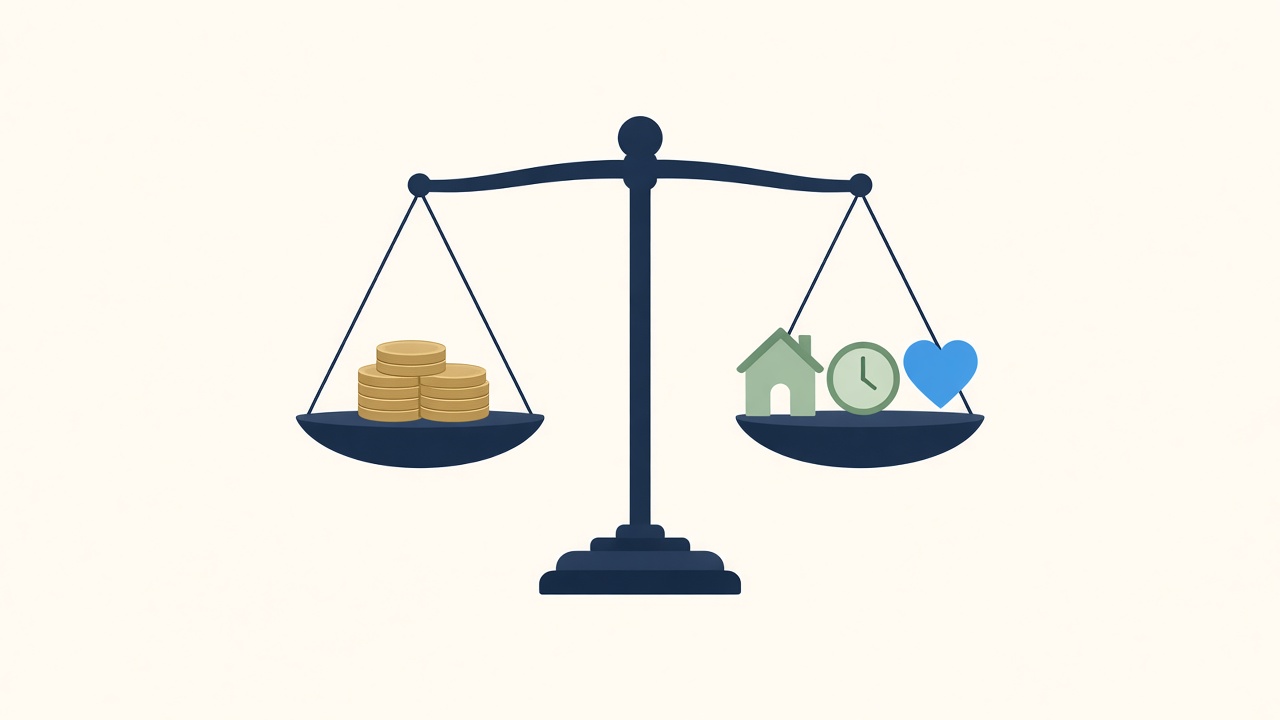
Money is a tool that stores your time and effort so you can use it later. Used well, it buys security, choices, time, and the ability to help other people. It is not a scoreboard. An obsession with money backfires because the goalposts keep moving: we adapt to every upgrade, compare ourselves to others, and trade away health, relationships and time to chase a number that never feels like enough. The end goal of money is freedom and peace of mind. That means time with the people who matter, room for purpose and generosity, and a family that inherits good values and habits along with any dollars. The practical way to get there is to define your own “enough” in layers: basics, then security, then freedom, then giving.
What Money Is For
Money is stored-up life. You trade time and effort for it, and it lets you spend that effort somewhere else, later. I wrote more about that trade in why time is the real currency.
Seen that way, money does four useful jobs:
- Security. A roof, food, a car that starts, and a cushion for when life happens. This is where money does its most obvious good.
- Choices and freedom. The ability to say no to a bad job, yes to a better opportunity, or “let’s wait” on a decision without panic.
- Time. Money can buy back hours: less overtime, a shorter commute, an earlier retirement, a free Saturday with your kids.
- The ability to help. Supporting family, helping a friend through a rough patch, giving to causes you care about.
Notice what’s missing: proving something. Money isn’t a scoreboard, and your balance doesn’t measure your worth. As I put it in rich vs. wealthy, looking rich and being wealthy are two very different things.
Does money make you happier? The research says yes, up to a point, and in a specific way. Kahneman and Deaton’s well-known 2010 study found that higher income kept improving how people rate their lives, but that day-to-day emotions seemed to level off. A later joint re-analysis by Killingsworth, Kahneman and Mellers (2023) refined that. For most people, happiness keeps rising with income, but in a “logarithmic” way: each bump takes a bigger raise than the last. The clearest benefit of more money was easing real unhappiness, the kind that comes from stretched budgets and constant worry. That fits the four jobs above. Money is excellent at removing problems. It’s much weaker at manufacturing joy.
Why Money Obsession Backfires
Wanting to be good with money is healthy. Being ruled by it is not. Here’s why obsession tends to backfire.
The hedonic treadmill
Psychologists use the term “hedonic adaptation” for our habit of getting used to things. The new car, the bigger house, the raise: each one feels great, and then it just feels normal. A classic 1978 study found that lottery winners weren’t happier than everyday people and actually took less pleasure in ordinary activities. It was a small study, but the pattern is familiar. Chase the feeling of an upgrade and you need a bigger one every time: running harder to stay in the same place.
Comparison and envy
Social media turns comparison into a full-time job. You’re comparing your real finances to everyone else’s highlight reel, and envy quietly turns “I’m doing fine” into “I’m behind.”
Trading away what actually matters
The 2010 study above found that things like health, caregiving and loneliness were stronger predictors of daily mood than income. Yet money obsession usually spends exactly those things: sleep, exercise, family dinners, friendships. Hoping money will buy them back later rarely works.
Fear-driven decisions
Obsession often runs on fear, which pushes two bad ways:
- Hoarding: never spending, never enjoying, never giving, because it might not be enough.
- Chasing: jumping into risky “get rich quick” bets because ordinary progress feels too slow.
It’s never enough
That’s the real trap: without a finish line, every milestone becomes the new starting line.
Signs money is running you
Be honest with yourself. Do any of these sound familiar?
- You check your balances or portfolio several times a day.
- A raise or windfall feels good for a week, then you’re already thinking about the next one.
- You feel worse about your finances after scrolling social media.
- You regularly miss family time or sleep to earn a little more.
- Spending even small, planned amounts on yourself or others makes you anxious.
- You’ve taken an investment risk mainly because you felt “behind.”
- You can’t say what number would be enough.
Ticked a few? You’re normal. It’s just a sign to redefine the goal.
The End Goal of Money
If money is a tool, the end goal is whatever the tool helps you build. For most of us, that comes down to four things.
1. Freedom and peace of mind. Not worrying about money is worth more than almost anything money can buy. I call it the “dividend of peace” in rich vs. wealthy, and it’s why the habits in this financial freedom post matter more than any single investment.
2. Time with the people who matter. As a dad, I know the years with kids at home go fast. Money that buys more of that time is money well spent.
3. Purpose and generosity. Giving is good for the giver too. In a 2008 study by Dunn, Aknin and Norton, people who spent money on others ended up happier than people who spent it on themselves, even with small amounts. Purpose also means using your money to create, not just consume. More on that in consumer vs. creator.
4. A legacy beyond dollars. What your kids see you do with money will outlast whatever’s in the account. Living within your means, saving on purpose, giving cheerfully, talking openly about money: those habits are an inheritance too.
How to set your own “enough” number
“Enough” is personal. Nobody can hand you a number, and I won’t pretend to. But you can build yours in four layers:
| Layer | What it covers | Question to ask |
|---|---|---|
| 1. Basics | Housing, food, transport, insurance, minimum debt payments | What does our life actually cost each month? |
| 2. Security | Emergency fund, no high-interest debt, adequate insurance | How many months could we handle a job loss or big surprise? |
| 3. Freedom | Investments that steadily replace the need to work, plus funds for the goals you care about | What would we do with more choice, and roughly what would it cost? |
| 4. Giving | Generosity and legacy: family, causes, community | Who and what do we want to support? |
A few tips as you work through it:
- Use real spending, not a fantasy budget.
- Write it down. A number on paper can be reached; one in your head keeps drifting.
- Separate “enough” from “nice to have.” Both are fine; just know which is which.
- Revisit it once a year. Life changes, and so can your number. Just don’t move it every time you see someone else’s.
Remember, savings are a bridge, not the destination. Your “enough” number tells you where the bridge is going.
Contentment and gratitude: the missing ingredients
Here’s the part spreadsheets can’t do. Contentment is the skill of enjoying what you already have, and gratitude is how you practice it. Noting a few things you’re thankful for each week can slow the treadmill. If you can’t be content with some of what you have now, a bigger number rarely fixes that.
Simple Action List
- Write one sentence about what you want money to do for your life.
- Total your basics using last few months’ real spending.
- Check your security layer: emergency fund and high-interest debt.
- Sketch your freedom number and the goals behind it.
- Pick one giving goal this year, however small.
- Mute or unfollow a few accounts that fuel comparison.
- Start a weekly gratitude note: three things, two minutes.
FAQ
What is money for, in simple terms?
It’s a tool that stores your time and effort to buy security, choices, time and the ability to help others.
Does more money make you happier?
Research suggests it helps, especially by easing financial stress, but each extra dollar does a bit less than the last.
What is the hedonic treadmill?
It’s our tendency to get used to improvements, so each upgrade’s happiness fades and we start wanting the next one.
How do I know how much money is enough?
Build it in layers: cover your basics, then security, then freedom, then giving. Base it on your real spending and your own goals, not anyone else’s.
Is it wrong to want to be wealthy?
Not at all. Wanting freedom and security for your family is healthy. The problem is when money becomes the scoreboard instead of the tool.
Disclaimer: This article is for educational purposes only and is not financial, investment, tax or legal advice. Everyone’s situation is different, so consider speaking with a qualified professional before making financial decisions.