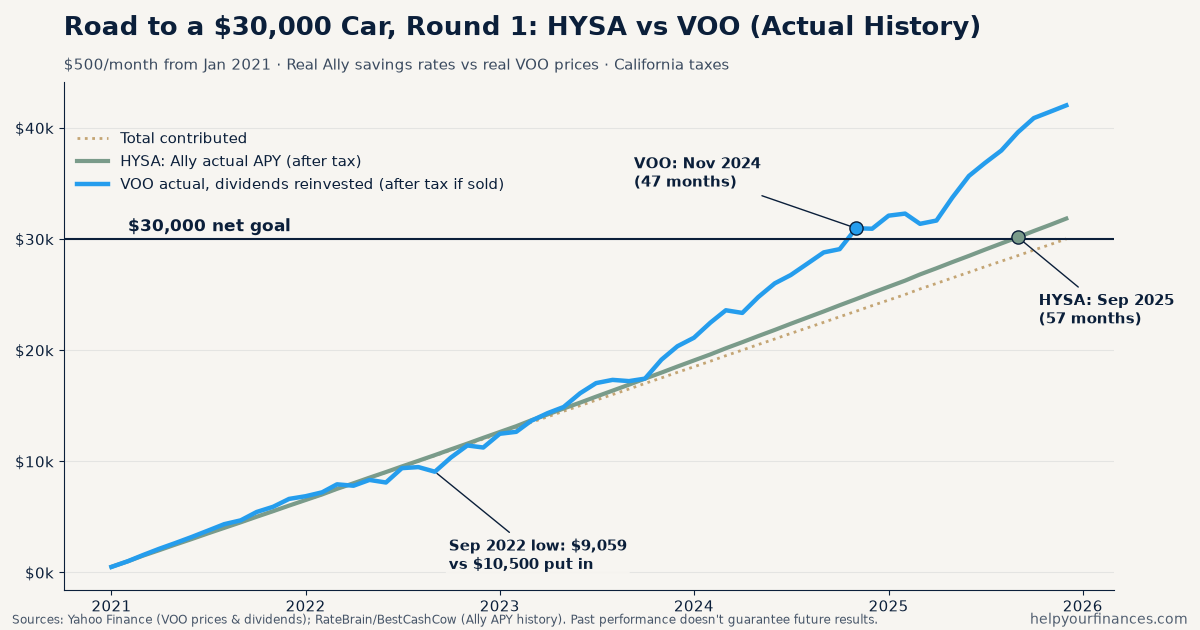
Welcome back to the bracket. In Day 1, Alex saved $500 a month starting in January 2021, and VOO beat a high-yield savings account to a $30,000 car paid in cash. Alex sold shares in November 2024, paid the tax, and drove away.
Today we throw a curve ball. What if Alex never sells?
Round 2: VOO (sell) vs. VOO (borrow).
The curve ball
Instead of selling, Alex keeps every share and borrows $30,000 against them. The loan is an asset-backed line of credit (often called an SBLOC or pledged-asset line). But there are rules:
- Alex can only borrow when the loan is about 60% of the account’s value or less. That’s the loan-to-value ratio, or LTV. For a $30,000 loan, VOO has to be worth at least $50,000. The point is to stay well clear of a margin call.
- The loan charges 8% interest.
- Once the loan starts, the $500 a month goes to paying it off. No new money goes into VOO until the loan is gone.
Meanwhile, in the sell path, Alex buys the car in November 2024 and keeps putting $500 a month into VOO.
Two questions: When does Alex get the car? And when the loan is finally paid off, which path left Alex with more?
Quick answer
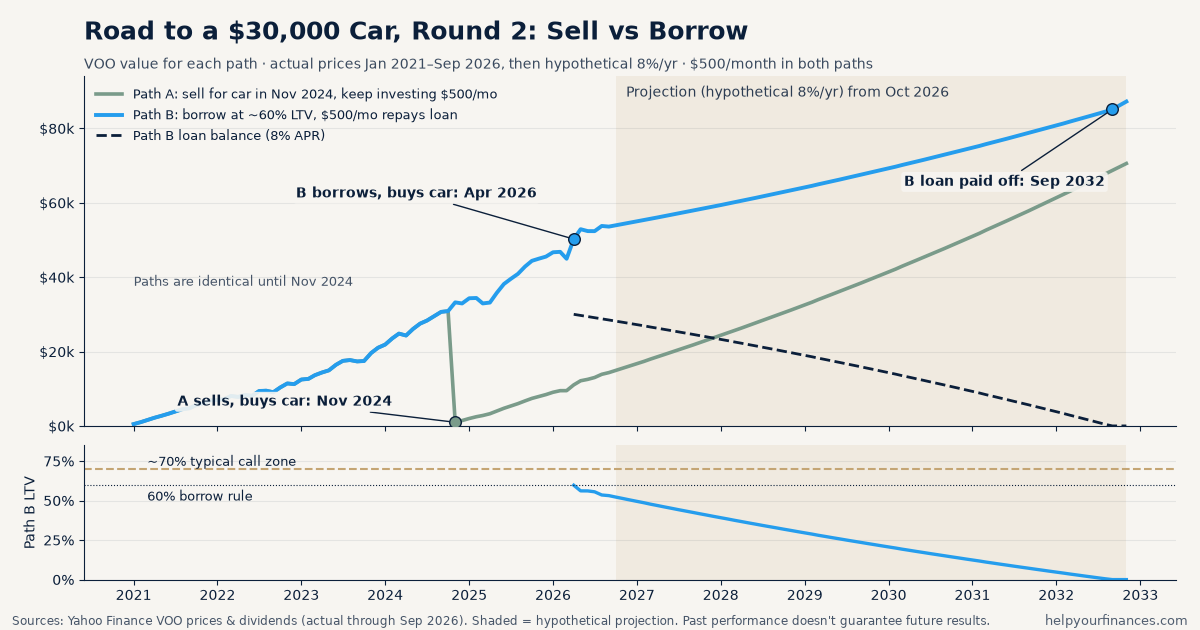
Selling gets Alex the car 17 months sooner. The sell path buys the car in November 2024. The borrow path has to wait until VOO crosses $50,000, which happens in April 2026. The loan is then paid off in September 2032, after $8,440 in interest.
But borrowing leaves Alex with more money at the end. In September 2032, the borrow path’s VOO is worth $85,087 vs $68,645 for the sell path. That’s about $16,400 more, and about $9,000 more even if Alex sold everything and paid the tax.
Under our updated scoring rule (explained below), that’s a split decision, and the bigger after-tax balance breaks the tie. VOO (borrow) advances.
One big caveat: our real data ends in September 2026. Everything after that uses a hypothetical 8% a year, and the borrow path’s lead was mostly built during real 2024–2026 market gains while Alex waited for the car.
The assumptions (read this first)
Assumptions box
- Both paths: start January 2021 with $500 into VOO on the 1st of each month. Same real-history rules as Day 1: actual VOO prices and dividends from Yahoo Finance, dividends reinvested, shares bought at the opening price on the first trading day of each month.
- Sell path (Day 1 winner): in November 2024, Alex sells just enough to net $30,000 after tax (oldest shares first; 24.3% on gains held more than a year, 31.3% on the rest). From December 2024 on, $500 a month keeps going into VOO.
- Borrow path: Alex keeps investing $500 a month until the first month-end when VOO is worth at least $50,000 (so a $30,000 loan is 60% LTV or less). That month, Alex borrows $30,000 at 8% a year (interest added monthly) and buys the car.
- Loan payments: $500 on the 1st of each month, starting the month after the loan. No new VOO contributions until it’s paid off. Any leftover from the final payment goes into VOO.
- No selling in the borrow path, so no capital gains tax. Loan interest on a personal car isn’t tax-deductible (more in the FAQ).
- Real data vs projection: actual VOO data runs January 2021 through September 2026. From October 2026 on, both paths use a hypothetical 8% a year. That’s a planning assumption, not a forecast.
- Same out-of-pocket money: in both paths, Alex spends exactly $500 every month, either into VOO or onto the loan. By September 2032, that’s $70,500 either way.
- No fees, a fixed 8% loan rate, and the car price stays at $30,000. Real securities-backed loans usually have variable rates.
New scoring rule
We’re updating the bracket rules, and we want to be upfront about it.
On Day 1, the winner was simply whoever got to the car first. That worked because VOO (sell) was both faster and ahead on money. This round showed that speed and wealth can disagree: one path gets the car sooner, while the other ends up with more. So from now on, each round is scored two ways:
- Outright win: if one path gets the car first and isn’t behind on after-tax wealth at the end, it wins.
- Split decision: if one path wins on speed and the other wins on wealth, the bigger after-tax balance breaks the tie. “After-tax” means what Alex would have if everything were sold and taxed, measured when the loan is paid off.
Round 1 doesn’t change. VOO (sell) won it on both counts.
Round 2 results
Contest 1: Who gets the car first?
| Sell path | Borrow path | |
|---|---|---|
| Car purchase | November 2024 (month 47) | April 2026 (month 64) |
| How | Sold $32,232 of VOO, paid $2,232 in tax | Borrowed $30,000 at 59.7% LTV |
| Wait vs sell path | — | 17 months longer |
Contest 2: Who has more when the loan is paid off (September 2032)?
| Sell path | Borrow path | |
|---|---|---|
| VOO value | $68,645 | $85,087 |
| Total out of pocket (deposits + loan payments) | $70,500 | $70,500 |
| Cost basis | $48,105 | $33,828 |
| Unrealized gain | $20,540 | $51,260 |
| Tax if Alex sold everything | $5,009 | $12,456 |
| Value after tax if sold | $63,636 | $72,631 |
| Loan balance | $0 | $0 |
| Capital gains tax already paid | $2,232 (Nov 2024 sale) | $0 |
| Total loan interest paid | $0 | $8,440 |
Sell wins Contest 1 and Borrow wins Contest 2, so under the new scoring rule this is a split decision, and Borrow’s bigger after-tax balance ($72,631 vs $63,636) sends it to Day 3. September 2032 is in the projection period (hypothetical 8% a year from October 2026). The “if sold” row is a yardstick. Not selling is the whole point of the borrow path.
The timeline: how each path played out
January 2021 to November 2024: the same road. Both paths are identical for the first 47 months. That’s Day 1: Alex rides out the 2022 drop and reaches $33,211 in VOO by November 2024.
November 2024: the paths split.
- Sell path: Alex sells about $32,232 of shares, pays $2,232 in tax, and buys the car. About $979 stays invested, and the $500 a month keeps going in.
- Borrow path: VOO is worth $33,211. A $30,000 loan would be 90.3% LTV, way over the 60% rule. So Alex keeps investing and keeps waiting.
March 2026: almost, but no. The account is worth $44,935. Borrowing then would have meant 66.8% LTV. Still too high.
April 2026: the borrow path gets the car. VOO jumps to $50,224, and the $30,000 loan is 59.7% of it. Alex borrows and buys the car, 17 months after the sell path did. At this point Alex has put in $32,000 and is sitting on about $16,700 of gains that were never taxed.
May 2026 onward: paying it down. The $500 a month now goes to the loan. With 8% interest, the first payment only knocks the balance from $30,000 to $29,700. By September 2026, the last month of real data, the loan is down to $28,480 and VOO is worth $53,581, so LTV has fallen to 53.2%.
September 2032: paid off. After 77 payments (the last one just $440, with $60 left over going into VOO), the loan is gone. Alex paid $38,440 in total: the $30,000 borrowed plus $8,440 of interest.
Why borrowing came out ahead (and why that’s not the whole story)
Both paths put in the same $500 every single month. So where did the borrow path’s extra $16,400 come from?
- It stayed invested while Alex waited. From November 2024 to April 2026, the borrow path kept all its shares, and VOO’s price rose about 19% (from $553.45 to $660.58). The sell path had cashed out most of its shares for the car.
- It never paid capital gains tax. The sell path handed $2,232 to the IRS and the state in 2024. The borrow path’s gains keep compounding untaxed.
- After September 2026, the head start just keeps growing. In both paths, the shares Alex already owns compound at the same projected 8%. Borrow’s bigger balance grows faster in dollars only because it’s bigger, so its lead grows with it. The monthly $500 is where the paths differ: in Sell, it buys new shares that earn 8%. In Borrow, it pays down loan principal, and every dollar of principal paid stops 8% interest from building on it. So the interest bill shrinks as the loan shrinks. That’s the same as earning 8% on that dollar. Neither path gains an edge from the $500 itself. In September 2026, net of the loan, Borrow was ahead by $10,768. That lead growing at 8% for six years comes to about $17,100, close to the $16,442 gap you see in 2032.
And here’s what the borrow path gave up: 17 months without the car, and $8,440 in interest. If VOO earns less than the loan rate after Alex borrows, the math tilts back toward selling.
LTV and margin calls, in plain words
LTV (loan-to-value) is how big your loan is compared to what your investments are worth. Borrow $30,000 against $50,000 of VOO, and your LTV is 60%.
The lender watches that number. If the market falls, your account shrinks but the loan doesn’t, so LTV goes up. Past a certain level (often around 70% for a fund like VOO, but it varies by lender), you get a margin call: pay down the loan or add more money, fast. If you can’t, the lender can sell your shares for you, often at the worst possible time, and that sale can trigger the very tax you were trying to avoid.
How did Alex do?
- Borrowing at 60% left real breathing room. LTV peaked at 59.7% on the day Alex borrowed, and the highest daily reading after that was 59.2% in early May 2026. It never got near 70%.
- To hit 70% right after borrowing, VOO would have needed to fall about 15% (to roughly $42,857). That’s not rare: VOO fell about 19% from mid-February to early April 2025.
- LTV drops quickly as the loan shrinks (in our projection): under 50% by January 2027, under 30% by January 2029, and under 20% by February 2030.
The scary version: what if Alex had ignored the 60% rule and borrowed in November 2024, right when the sell path bought the car? LTV would have started at 90.3%. Most lenders wouldn’t allow that. Then the April 2025 tariff drop hit. At the close on April 8, 2025, the account was worth about $27,591 while Alex still owed $28,480. That’s an LTV of 103%: the loan was bigger than the shares backing it. That’s a guaranteed margin call and a forced sale. The 60% rule is what kept the borrow path safe.
A stricter rule costs time. If Alex waited for 50% LTV (VOO at $60,000), the car would wait until February 2027 (in our projection), and the loan would be paid off in July 2033.
For a deeper look at borrowing against investments, read The Truth About Margin Investing: Risk, Reward, and Reality.
The verdict: a split decision, and borrowing advances
- Speed goes to Sell. Alex gets the car in November 2024 instead of April 2026. That’s 17 months sooner.
- Wealth goes to Borrow. When the loan is paid off in September 2032, the borrow path is ahead by about $8,995 after tax if Alex sold everything ($72,631 vs $63,636), and $16,442 before tax ($85,087 vs $68,645).
That’s a split decision. Under our new scoring rule, the bigger after-tax balance breaks the tie, so VOO (borrow) advances to Day 3.
Selling still has a real case. Alex drove the car for 17 extra months, paid no interest, and never had to watch an LTV number. And borrowing’s win depends on two things: real 2024–2026 market gains while Alex waited, and a hypothetical 8% a year after September 2026. If you can wait, keep your LTV low, and have a steady income to make the payments, borrowing let Alex keep the investments working. Just remember it only worked because the market cooperated and Alex never let the loan get too big.
Coming up on Day 3: VOO (borrow) vs SPYI (borrow)
SPYI is a covered-call ETF that pays big monthly income. On Day 3, both sides borrow, under the same rule: Alex can only take the $30,000 loan when it’s about 60% LTV or less. Can SPYI’s monthly income help pay off the loan faster? Or do taxes and slower growth eat the advantage? We’ll score it the same way: who gets the car first, and who has more after tax when the loan is paid off.
The bracket:
- Day 1: HYSA vs VOO (sell) → VOO (sell) advances
- Day 2: VOO (sell) vs VOO (borrow) → VOO (borrow) advances (split decision)
- Day 3: VOO (borrow) vs SPYI (borrow), same 60% LTV rule
- Bonus round: a $250 VOO / $250 SPYI split
FAQ
What LTV is safe when borrowing against stocks?
There’s no perfectly safe number, but lower is safer. Many lenders let you borrow up to about 50–70% on a broad stock fund, and they can call the loan when LTV rises past their limit. Starting around 60% or lower, like Alex did, leaves room for a normal market drop. Starting near the limit can mean a forced sale in the next dip.
Is interest on a securities-backed loan tax-deductible if I use it to buy a car?
Generally, no. Interest on money borrowed for personal use, like a car, isn’t deductible. The newer federal deduction for car loan interest (2025–2028) only applies to loans secured by a first lien on a new, U.S.-assembled vehicle. A loan backed by your investments doesn’t count. Interest is usually deductible as investment interest only when the borrowed money is used to buy investments.
Why not just borrow against stocks forever and never sell?
Some wealthy investors do use “buy, borrow, die.” But it only works if your investments grow faster than your loan costs over time, and if you can survive the dips without a margin call. Rates on these loans are usually variable, so 8% can become 10%. And every dollar of interest is a guaranteed cost, while market returns aren’t guaranteed.
Disclaimer: This article is for educational purposes only and isn’t financial, tax, or investment advice. Results use actual VOO prices and dividends from Yahoo Finance through September 2026, and a hypothetical 8% annual return after that, which is not a prediction. The loan terms (8% fixed, borrowing at 60% LTV) are simplified assumptions. Real securities-backed loans have variable rates, lender-specific limits, and margin call rules. Tax rates are simplified. Past performance doesn’t guarantee future results. Talk to a qualified professional about your own situation.