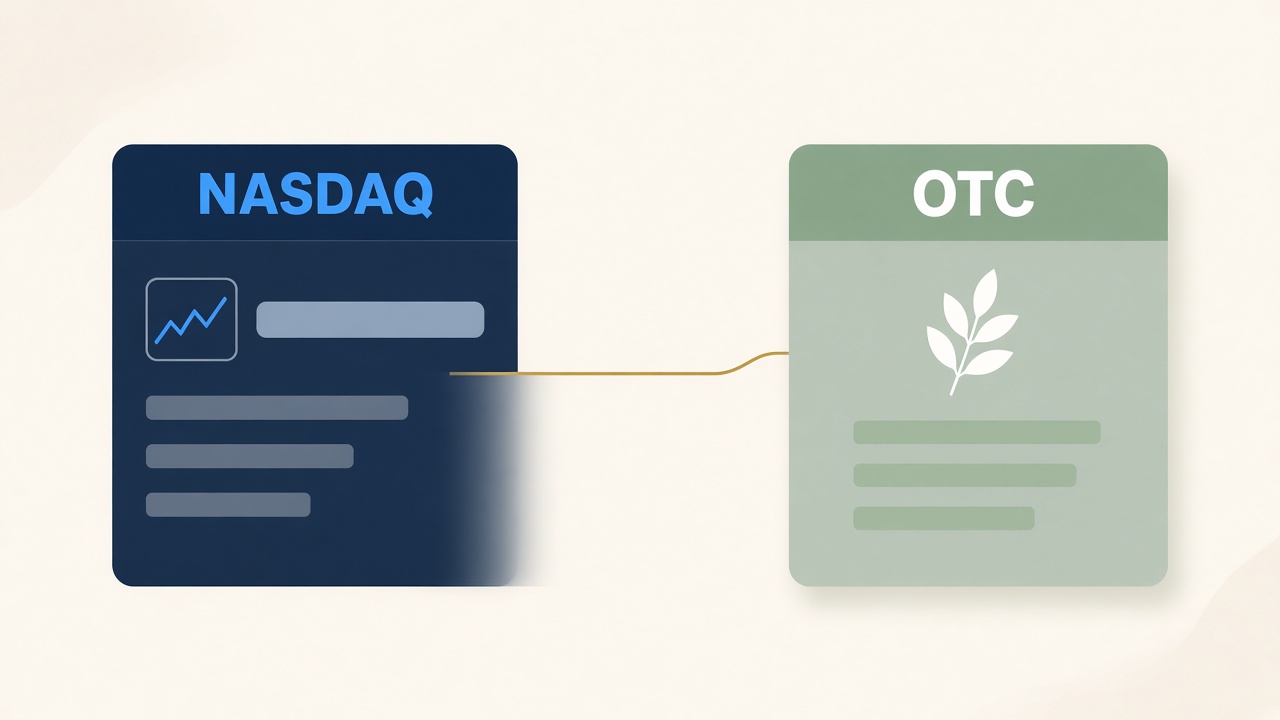
Quick answer: A NASDAQ delisting means the stock no longer trades on that exchange. You usually still own the same shares. Trading may move to the over-the-counter (OTC) market, become thinner and harder to follow, or—especially in bankruptcy—end with shares cancelled or worth little to nothing. Delisting is about where and how the stock trades, not an automatic “delete button” on your ownership.
If you hold a stock that just got a deficiency notice—or one that already left NASDAQ—this guide walks through what that means in plain English, what you can do next, and two real company stories: one that largely disappeared for shareholders, and one that left NASDAQ and later relisted.
What “delisted from NASDAQ” actually means
NASDAQ is a national securities exchange with continued listing standards. When a company no longer meets those standards—or when exchange rules allow staff to force a removal after events like a bankruptcy filing—NASDAQ can suspend and then remove the security from its listings.
Delisting is not the same thing in every case:
- Exchange delisting → still a public company (often OTC). Shares may keep trading off-exchange if market makers can quote them under applicable rules. Liquidity is often worse. Spreads can widen. News and filings may still exist—or may dry up.
- Going dark / reduced reporting. Some companies stop or fall behind on SEC periodic reports. That can make the stock much harder to value and, for some OTC quotes, harder for brokers to support.
- Bankruptcy. A Chapter 11 reorganization or Chapter 7 liquidation can lead to quick exchange delisting. Your shares may keep trading with a “Q” warning in the ticker for a while, but equity is last in line. Plans often cancel old common stock.
- OTC / Pink quotation. After a NASDAQ exit, many names try to trade on OTC venues (including Pink / OTC Link ATS). Quotation is not automatic. A broker-dealer still has to be willing and able to quote under SEC Rule 15c2-11 and venue rules.
Bottom line for shareholders: Delisting changes the marketplace around your shares. It does not, by itself, transfer your ownership to someone else. What happens after—liquidity, reporting, restructuring, or cancellation—is what decides whether those shares still have practical value.
Common reasons NASDAQ delists (or starts the process)
Companies can fail continued listing standards for several well-known reasons. Exact thresholds depend on which NASDAQ market the stock is on (Global Select, Global, or Capital Market) and which rule applies, but these themes show up again and again in company 8-K filings:
1. Bid price below $1
If the closing bid stays below $1.00 for 30 consecutive business days, Nasdaq typically sends a deficiency notice. For many issuers, Listing Rule 5810(c)(3)(A) then provides about 180 calendar days to regain compliance—often by posting a closing bid of at least $1.00 for a minimum of 10 consecutive business days during the cure window. Some Capital Market companies can get a second 180-day period if they meet other conditions and tell Nasdaq they intend to cure (often via a reverse split).
Important exception: If the closing bid falls to $0.10 or less for 10 consecutive trading/business days, Nasdaq’s “low priced stocks” rule can accelerate a delisting determination and take away the normal bid-price cure period.
2. Market value / shareholder equity shortfalls
Nasdaq also polices standards such as market value of listed securities, market value of publicly held shares, and—on the Capital Market—minimum stockholders’ equity (or alternative income / market-value tests). Falling short can trigger a separate deficiency path, sometimes with a compliance plan deadline instead of (or in addition to) a bid-price clock.
3. Late SEC filings
Missing a Form 10-K or 10-Q on time is a classic listing problem. Nasdaq and investors both rely on current financial reporting. Extended late-filer status often leads to a Staff delisting determination if the company cannot catch up under the panel’s timeline.
4. Regulatory / public-interest noncompliance
Nasdaq can act under discretionary / public-interest rules when a company files bankruptcy, when residual equity looks questionable, or when other serious compliance issues arise. Bankruptcy-related notices commonly cite Listing Rules 5101, 5110(b), and IM-5101-1.
Other triggers can include corporate governance failures, reverse-split history limits, or failing to hold required shareholder meetings—always check the company’s own 8-K rather than assuming.
The usual timeline (deficiency → OTC)
Every case is a little different, but retail investors usually see a sequence like this:
- Deficiency notice. The company files an 8-K (often Item 3.01) saying Nasdaq Staff found a listing problem. Trading on Nasdaq often continues during a cure period.
- Cure period. For bid-price issues, think in terms of months (commonly 180 days, sometimes extendable). For other issues, Staff may require a compliance plan by a set date.
- Staff delisting determination. If the company does not cure, Nasdaq says the stock is subject to delisting.
- Appeal / hearings panel. The company can usually request a hearing. A timely appeal can stay suspension while the panel decides. There is no promise the appeal succeeds.
- Suspension. Trading on Nasdaq stops, often at a stated open of business.
- Formal removal. Nasdaq files paperwork with the SEC (historically a Form 25-NSE path) to remove the listing.
- OTC / Pink (if any). The company or market makers may arrange OTC quotation under a new or modified symbol. It may trade actively, thinly, or barely at all.
Practical tip: Read the company’s 8-K dates carefully. “Notice of deficiency” is not the same as “trading suspended tomorrow.”
What happens to your shares
You still own them (until a legal process says otherwise)
Delisting alone does not confiscate your stock (if you want a refresher on what share ownership actually gives you, see Stock Market Basics: What Does It Mean to Own a Stock?). Your broker should still show a position. In bankruptcy or a going-private deal, a later court order or corporate action—not the delisting notice itself—is what can cancel or convert shares.
Liquidity and spreads often get worse
On Nasdaq, many stocks have tighter markets and broader visibility. On OTC Pink, you may face:
- wider bid–ask spreads
- lower volume
- harder order fills
- broker warnings or trading restrictions on certain OTC names
Reporting quality can change
Some delisted companies keep filing full SEC reports. Others fall behind or deregister. Less disclosure usually means more risk—and, under modern quotation rules, can also mean fewer broker quotes.
Options
If you hold options on the stock, the Options Clearing Corporation and your broker control adjustments, exercise rules, and whether series become close-only or cash-settled. Do not assume options vanish the day the equity leaves Nasdaq—and do not assume they remain easy to trade. Check your broker and any OCC memos for that symbol.
Forced sales are uncommon—but broker rules matter
Brokers rarely “force sell” solely because a name left Nasdaq. They can restrict OTC trading, raise margin requirements, or liquidate if you violate margin/maintenance rules. If you use margin, a delisting-related price drop can matter as much as the venue change. (See also our deeper dive: The Truth About Margin Investing: Risk, Reward, and Reality.)
Tax and broker basics (high level only)
This is not tax advice—just a map of questions to ask:
- Still holding after a big drop: An unrealized loss is not the same as a deductible capital loss. A deductible loss usually needs a closed transaction (sale, or certain worthlessness / cancellation events recognized under tax rules).
- Selling on OTC: A sale can still be a taxable event. Basis, holding period, and wash-sale rules still matter if you buy a “substantially identical” security around the same time.
- Bankruptcy cancellation: If shares are cancelled for no distribution, investors often treat that as a total loss—but the timing and paperwork (broker 1099-B, worthlessness claims, etc.) can be messy. Get a tax professional involved before you file.
- Broker quirks: Some platforms limit Pink Sheet orders, require extra agreements, or show delayed quotes. Confirm you can actually trade the symbol before you need an emergency exit.
When in doubt, save every 8-K, broker statement, and corporate notice. Paper trails help at tax time. For the basics of how realized losses can offset gains, see Offsetting Capital Gains with Losses Can Reduce Taxes.
What shareholders should do (a practical checklist)
- Read the 8-K, not just the headline. Note whether this is a deficiency, a Staff determination, an appeal, or an actual suspension date.
- Check your broker. Can you still trade the symbol? Any OTC restrictions? Margin call risk?
- Separate “venue problem” from “business problem.” A reverse-split cure after a temporary bid-price miss is different from Chapter 11 with no equity recovery.
- Follow SEC EDGAR. Search the company CIK for 8-Ks, late-filing notices, and bankruptcy-related exhibits.
- Use company investor relations. Press releases often explain OTC symbols, reverse splits, and hearing dates.
- Decide on a plan—don’t freeze. Options usually include hold (if you accept OTC / restructuring risk), sell (if liquidity still exists), or average-down only if you truly understand the upside case. Panic sells and blind “lottery ticket” holds are both common mistakes.
- If options or concentrated positions are involved, talk to a fiduciary advisor or tax pro who can look at your account.
Diversification is still the boring hero here. One delisting rarely sinks a portfolio built mainly on broad index funds—but it can hurt badly if the name was a large single-stock bet. (More on that trade-off in S&P 500 ETF vs Single Stocks: Which Is Better for You?)
Case study 1: Sears Holdings — delisted in bankruptcy, little left for shareholders
What happened: Sears Holdings Corporation filed Chapter 11 on October 15, 2018. The same day, Nasdaq Staff determined the common stock and warrants would be delisted under bankruptcy-related listing rules. The company said it would not appeal; Nasdaq trading was expected to suspend at the open on October 24, 2018, with OTC Pink trading expected under SHLDQ. Nasdaq’s later delisting determination removed the stock effective at the open on November 26, 2018.
For shareholders, this is the hard version of delisting. Moving to OTC did not fix the capital structure. In a corporate bankruptcy, creditors come before common equity. The SEC’s Investor.gov bankruptcy bulletin warns that common stock in a bankrupt company is “likely to be worthless,” because equity is last in line behind creditors and reorganization plans often cancel existing shares, leaving “little or nothing of value” for old shareholders.
Sears is a clear public-record example of a major retailer whose exchange exit came bundled with insolvency—and where buy-and-hope after the “Q” ticker appeared was an extremely risky stance.
Sources: Sears Holdings Form 8-K (Oct. 15, 2018); Nasdaq delisting determination; Investor.gov investor bulletin on bankruptcy.
Case study 2: Tuesday Morning — delisted from NASDAQ, then relisted
What happened: Tuesday Morning Corp. was removed from Nasdaq effective at the open on July 13, 2020, after a bankruptcy-related Staff delisting determination (company notified May 27, 2020; determination final June 8, 2020 when it did not appeal).
That was not the end of the public-market story. On May 24, 2021, the company announced Nasdaq had approved its application to relist on the Nasdaq Capital Market, with trading expected to resume on or about May 25, 2021 under ticker TUEM (it had been trading on OTCQX).
That path—Nasdaq → OTC → Nasdaq again—is uncommon, and it is the clearest “came back” lesson for this article: a delisting can be temporary if the company repairs its listing qualifications and Nasdaq accepts a new listing application.
Important framing: Relisting restores exchange access and visibility. It is not a lifetime guarantee. Retail turnarounds can still fail later, so a return to Nasdaq is a reason to re-check the business, not a reason to stop paying attention.
Sources: Nasdaq delisting determination; Tuesday Morning relisting announcement (May 24, 2021); Retail Dive coverage.
How to monitor a delisting situation
| Watch this | Why it helps |
|---|---|
| Broker account / alerts | Confirms symbol changes, trading halts, OTC eligibility, margin impact |
| SEC EDGAR (company filings) | 8-K Item 3.01 notices, hearing outcomes, bankruptcy exhibits |
| Company investor relations | OTC symbol, reverse-split mechanics, cure plans |
| Nasdaq / press releases | Suspension dates and panel decisions when the company republishes them |
| Options / OCC notices | Only if you hold listed options on the name |
A simple weekly habit during a cure period: skim EDGAR for new 8-Ks and confirm your broker still supports the symbol you think you hold.
FAQ
Does delisting mean I lose my shares?
Usually no. Delisting changes the trading venue. You can still lose economic value if the price collapses, liquidity vanishes, or a bankruptcy plan cancels the equity.
Will my stock automatically trade on OTC Pink?
No. OTC quotation depends on market-maker quoting rules and information requirements. Some names trade actively off-exchange; others barely trade.
How long does a company get to fix a sub-$1 Nasdaq bid price?
Often an initial 180-calendar-day compliance period after a 30-business-day deficiency, with a possible second 180-day period for some Capital Market companies. Very low-priced stocks (around $0.10 or below for 10 straight sessions) can face a faster path.
Should I sell immediately after a deficiency notice?
Not automatically. A deficiency notice is a warning, not always an imminent suspension. Judge the cause (temporary bid-price miss vs. bankruptcy vs. fraud/reporting failure), your position size, and whether you can tolerate OTC or total-loss risk.
Can a delisted stock return to NASDAQ?
Yes—some companies regain compliance before they are removed; a smaller set, like Tuesday Morning in 2021, leave and later satisfy initial listing standards again. It is possible, not typical, and never guaranteed.
Key takeaways
- Delisted ≠ automatically deleted. Ownership usually remains until a sale, transfer, or legal cancellation.
- The reason matters more than the headline. Bid-price cures and bankruptcy liquidations are different planets.
- Expect worse liquidity off-exchange. Wider spreads and thinner volume are common.
- Use primary documents. Broker + EDGAR + IR beat social-media rumors.
- Case studies cut both ways. Sears shows how exchange exit plus insolvency can leave shareholders with little; Tuesday Morning shows a verified Nasdaq relisting is possible—without promising a happy ending forever.
Disclaimer: This article is for educational and informational purposes only and does not constitute investment, tax, or legal advice. HelpYourFinances.com and the author are not advising you to buy, sell, or hold any security. Listing rules, bankruptcy outcomes, broker policies, and tax treatment vary by situation and can change. Consult a qualified financial advisor, tax professional, or attorney about your circumstances. Past company examples are historical illustrations, not predictions.