If you’re new to investing or early in your career, this is the story I wish I’d read before I talked myself out of starting.
I didn’t start investing because I felt rich.
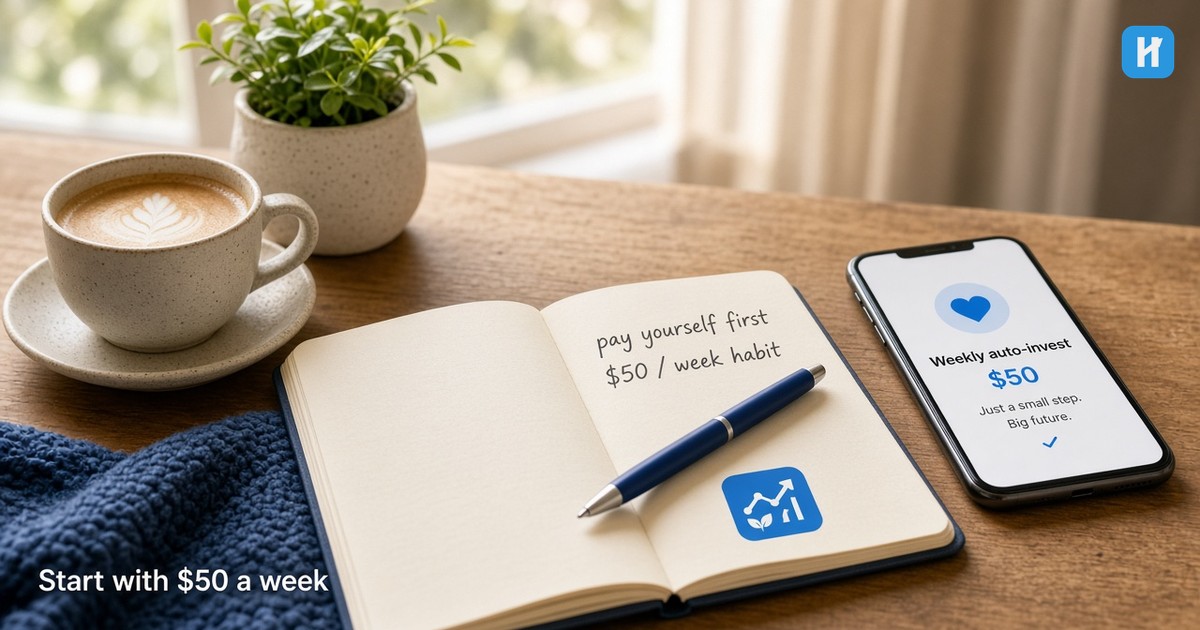
I started because I was tired of watching small money disappear — and I wanted a real answer to how to start investing with $50 a week without needing a finance degree.
In May 2023, I ran a simple experiment: instead of letting a casual $50 latte-style habit leak out of my week, I set up automatic investing from my paycheck into VOO — a fund that owns a broad slice of large U.S. companies (the S&P 500 idea, in ETF form).
I wrote about that beginning here: Investing in VOO.
No perfect timing. No giant lump sum. Just start investing $50 a week, on repeat.
That was the whole strategy.
What dollar-cost averaging looked like in real life
Dollar-cost averaging for beginners is simpler than the name sounds: you invest a fixed amount on a fixed schedule — like $50 every week — whether the market feels exciting or scary. Some weeks you buy when prices are higher; some weeks you buy when they’re lower. Over time, the habit matters more than guessing the perfect day.
That’s what I did. Same calendar. Same transfer. Less drama.
The first quiet win
By March 2024, the experiment didn’t look flashy on paper — and that was the point.
- I’d contributed about $1,900
- The account was worth about $2,100
- That’s roughly a 12% unrealized gain at that moment (meaning: on paper, up — not cash I’d sold)
It wasn’t “life-changing money.”
It was proof.
Proof that a small automatic habit could grow into something I could see.
For a beginner investor or young investor, that matters more than people admit. Confidence is part of the system. If you never start, you never get the feeling that says: oh… this actually works.
Then I let the habit expand (carefully)
Around May 2024, I started adding QQQ at $50 a week — a Nasdaq-100 growth-oriented ETF a lot of people use when they want more exposure to big innovators.
I wasn’t trying to become a day trader. I was raising the automatic pay yourself first investing amount as the habit felt normal.
By June 2025, the portfolio crossed $10,000.
That milestone has its own story here: $50 Weekly Investing Plan Reaches $10K.
Two numbers stuck with me:
- It took about 24 months to go from $0 → $10,000
- The climb didn’t come from genius stock picks — it came from showing up every week
The weekly plan (VOO, QQQ, VIG, SCHG) — simple, not fancy
Around July 2025 — roughly the third anniversary of the $50 behavior — I added VIG.
VIG, in plain English, is a Vanguard ETF focused on companies with a history of growing their dividends over time. Not “highest yield at all costs” — more like quality businesses that have raised payouts.
At that point the weekly plan looked like this:
- $50 → VOO
- $50 → QQQ
- $50 → VIG
- Total: $150/week
Still automatic. Still boring on purpose.
In May 2026, for the fourth anniversary, I added SCHG.
SCHG, in plain English, is a Schwab ETF that leans into U.S. large-cap growth companies — businesses investors often associate with expansion and innovation.
I wasn’t reinventing the plan. I was stacking another long-term brick onto a habit that had already survived four years of real life.
(Over time I may refine which funds get the weekly buys — fees and simplicity matter. For example, I’ve also written about why I moved new Nasdaq-100 DCA money toward QQQM — but this story keeps the historical QQQ habit as it happened.)
Where it stands now (September 2026)
This is my personal experiment — not a promise of what anyone else will earn:
- Contributed: about $19,900
- Unrealized gain: about $5,400
- Portfolio value: about $25,300
From $0 → ~$10k took roughly 24 months. From there to ~$25k took about another 16 months.
That second stretch is where compounding starts to feel less like a textbook word and more like a quiet accelerator: your earlier contributions have had more time to work, while new weekly deposits keep feeding the machine.
(Markets go down too. Unrealized gains can shrink. This is one person’s path through one window of time.)
Beginner lessons if $50 a week feels too small
1) Start somewhere
Waiting for the perfect month is how years disappear. My start was imperfect and tiny — and it still created a trail I could follow.
2) It’s okay if it’s small
$50 a week didn’t feel powerful in week one. It felt almost silly.
That’s fine. Small + repeated beats big + imaginary.
3) A positive habit + automation compounds
Willpower is unreliable. Automation is loyal.
The best investing decision I made wasn’t a ticker — it was removing the weekly “should I?” argument with automatic investing from paycheck mechanics.
4) Pay yourself first
If the money hits your checking account and waits for your mood, lifestyle usually wins.
So the order that works in real life looks like this:
- Auto-deposit / protect a cash cushion (emergency fund thinking)
- Knock down high-interest debt that quietly eats future options
- Auto-invest what you’ve planned — even if it’s small
That’s paying yourself first in practice: future-you gets funded before leftover-you goes shopping.
What’s next: the long walk toward $100,000
I’m not pretending the next stretch is a straight line.
I am aiming the same machine at a bigger milestone: $100,000.
If the early years taught me anything, it’s this:
- the first dollars feel slow
- the habit is the product
- time + consistency do more marketing than hype ever will
I’m not abandoning the core idea that got me here:
start small, automate it, and let the calendar do heavy lifting.
FAQ: starting investing with $50 a week
Can I start investing with $50 a week?
Yes — many brokers let you automate small recurring buys, and fractional shares (where available) make a fixed weekly amount practical. The bigger barrier is usually consistency, not the round number.
What is paying yourself first when you invest?
It means funding your future before lifestyle spending gets the first claim on your paycheck — often through automatic transfers into savings and investments so you don’t rely on leftover willpower.
Is dollar-cost averaging good for beginners?
For many beginners, yes: a fixed schedule reduces the pressure to “time” the market and turns investing into a habit. It doesn’t remove risk, and it isn’t magic — it’s a process you can stick with.
Do I need to pick stocks, or can I use ETFs like VOO?
You don’t have to pick individual stocks to begin. Broad ETFs like VOO are one common beginner-friendly way to own a diversified basket of companies in a single fund.
Will I get the same results as this story?
No — and you shouldn’t expect to. These are personal results from one contribution schedule and one market window. Your returns can be higher or lower, and past performance does not guarantee future results.
If you’re at the “I’ve never invested” stage, you don’t need my exact tickers on day one. You need a first automatic transfer you can keep.
Explore more beginner-friendly guides on Help Your Finances, or join the newsletter for practical, no-drama personal finance.
This article shares a personal investing experiment for educational and informational purposes only. It is not financial, investment, tax, or legal advice. Results described are individual, based on specific contribution amounts and market conditions during this period, and are not typical or guaranteed. Markets fluctuate; past performance does not predict future results. Consider your own situation and, if needed, consult a qualified professional before making investment decisions.