Every “bulletproof” portfolio I’ve built or reviewed has one boring piece in it that matters more than it looks: an almost-cash sleeve. Its price barely moves, it still earns income, and you spend from it when the stock market is having a bad month.
That’s the whole trick. Most portfolios don’t break because the stocks were bad. They break because someone had to sell stocks at the bottom to pay rent. A near-cash sleeve gives you time. You live off it while equities recover, and you don’t lock in losses.
The two names I get asked about most for this job are Fidelity’s SPAXX and iShares’ SGOV. Both are about as close to “cash that pays you” as you can get, and either one does the job. They’re not identical, though, and the differences start to matter once the buffer gets big.
Here’s how I think about it.
What each one is, in plain English
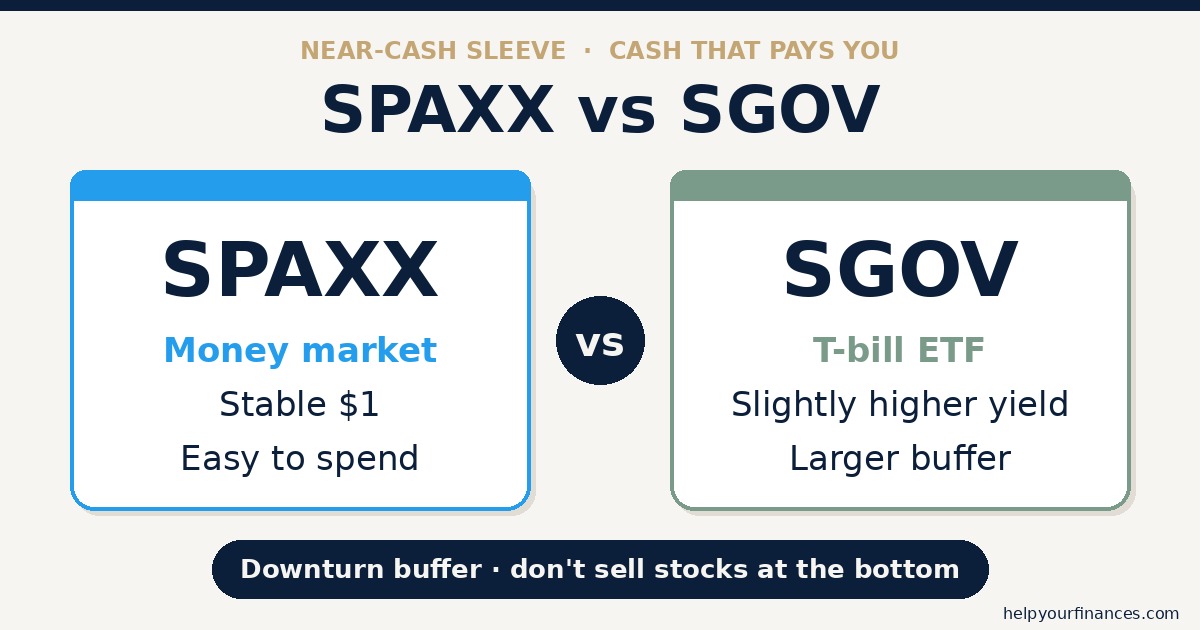
SPAXX (Fidelity Government Money Market Fund) is a government money market mutual fund. It aims to keep its price at $1.00 a share and pays you interest that accrues daily and is paid monthly. At Fidelity, it’s usually the core position, meaning the default spot where your cash sits. Debit-card swipes, bill pay, and trades come straight out of it, with no selling step.
SGOV (iShares 0–3 Month Treasury Bond ETF) is an exchange-traded fund that holds U.S. Treasury bills maturing within three months. It trades around $100 a share, and the price moves very little. Over the last 52 weeks it ranged from $100.27 to $100.74, and its effective duration is about 0.11 years, so interest-rate risk is tiny. It pays monthly distributions, and you can buy it at almost any brokerage.
One quirk worth knowing: SGOV’s price creeps up a little during each month as interest builds, then drops by roughly the distribution amount on the ex-date. On 11/2/2026, for example, it dropped about $0.32 against a $0.3286 dividend. That isn’t a loss. The money moved from the share price into your account as cash.
SPAXX vs SGOV side by side
Figures are the latest each issuer published as of early November 2026. Yields change with T-bill rates, so check them again before you act.
| SPAXX | SGOV | |
|---|---|---|
| What it is | Government money market fund, stable $1 NAV | ETF of U.S. T-bills maturing in 0–3 months |
| Current yield | 3.56% 7-day yield (11/2/2026); 3.62% compound effective | 3.79% 30-day SEC yield (10/30/2026) |
| Expense ratio | ~0.42% (third-party figure, still to be confirmed with Fidelity); the quoted yield is already net of fees | 0.09% |
| Recent returns | 1 yr 3.42%, 3 yr 4.18% annualized | 1 yr 3.74%, 3 yr 4.54% annualized (NAV) |
| Price stability | Held at $1.00 | ~$100; 52-week range $100.27–$100.74 |
| Liquidity | Core cash at Fidelity: same-day, no trade needed | Trades in market hours, settles T+1; spread ~0.01% |
| Minimum | $0 | 1 share (~$100), or fractional at some brokers |
| Federal tax | Ordinary income | Ordinary income |
| State tax | Mostly taxable (only the direct-government share is exempt) | Generally exempt on the Treasury share (~99.5% of holdings), subject to state rules |
| Where you can hold it | Fidelity only | Almost any brokerage |
| Best for | Spending money, emergency fund, cash waiting to be invested | A larger buffer (6–24 months of withdrawals), taxable accounts in high-tax states |
The short version: SGOV pays a bit more, costs less, and is usually friendlier on state taxes. SPAXX is simpler to use.
When SPAXX wins
SPAXX is the better choice when convenience matters more than a few basis points:
- You need the money today. Debit card, bill pay, or a transfer out, and nothing has to be sold first.
- You want a price that doesn’t move, so the balance you see is the balance you have.
- The amount is small. On a few thousand dollars, the yield and tax differences come to pocket change.
- It’s in an IRA or 401(k), where state-tax treatment doesn’t matter. Even there, SGOV’s lower fee still gives it a slight edge, but the gap is small.
When SGOV wins
SGOV is the better choice when the buffer is big and sits for months:
- The sleeve is large. On $100,000, the roughly 0.23-point yield gap works out to about $230 a year, and that’s before the state-tax benefit.
- You live in a high-tax state (California, for example) and hold the buffer in a taxable account. Because nearly all of SGOV’s income comes from Treasuries, it’s usually exempt from state income tax. Most of SPAXX’s income isn’t.
- You’re not at Fidelity, or you want the same holding at every broker you use.
- You can wait one day for a sale to settle. A downturn rarely needs your cash within the hour. You usually see it coming over weeks, not minutes.
My practical setup: use both
I don’t think this has to be either/or. The setup I like:
- 1–3 months of spending in SPAXX (or whatever your broker’s core cash fund is). This is the “spend” bucket. Bills come out of it with no trade.
- The rest of the near-cash buffer in SGOV. This is the “refill” bucket, and it earns a bit more while it waits.
You get the convenience of a $1.00 fund for day-to-day spending and the better yield, lower fee, and tax treatment of T-bills for the bigger pile.
How to use it in a downturn
This is where the sleeve earns its keep. The playbook is simple on purpose, because you’ll be following it while the headlines are scary:
- Spend from SPAXX. Keep 1–3 months of withdrawals there and let your regular bills draw it down.
- Hold the rest in SGOV. That’s your reserve of months.
- When stocks fall, stop selling equities. Refill SPAXX by selling SGOV, which has essentially no price drop to lock in. If you’re feeling brave and the plan calls for it, you can also rebalance by selling some SGOV to buy stocks at lower prices.
- When markets recover, rebuild the sleeve from equity gains or dividends, so the buffer is full before the next rough patch.
That’s it. The point is to separate when you need cash from when you sell stocks. The sleeve gives you enough time that a crash becomes a waiting game instead of a forced sale.
How this fits the $500K bulletproof blueprint
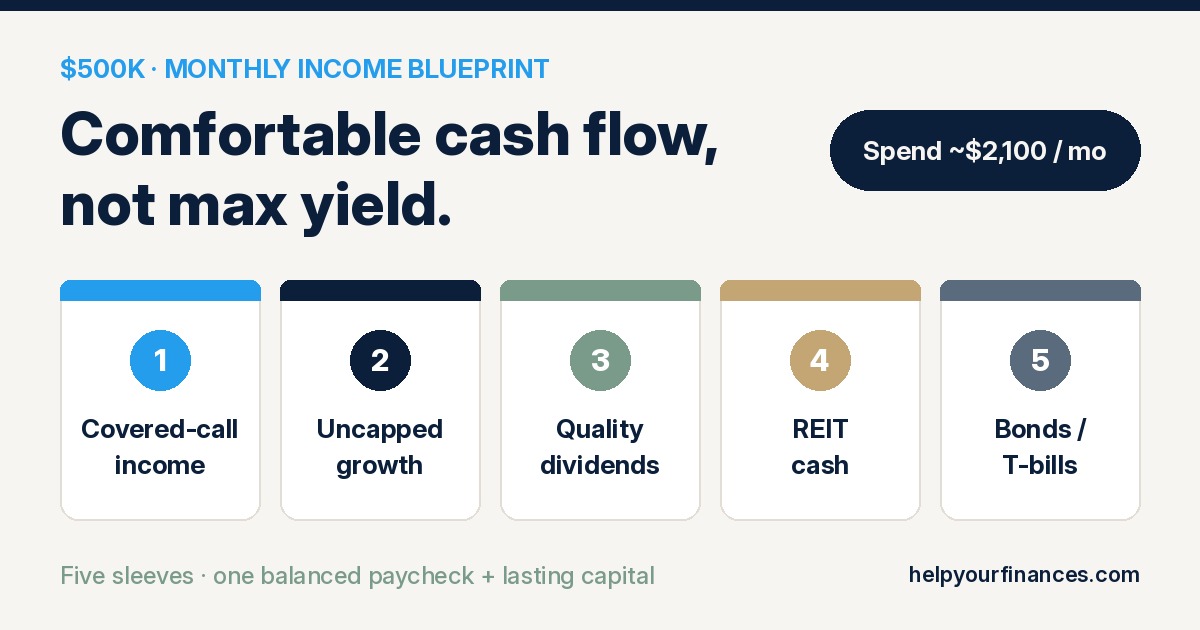
In my Bulletproof Monthly Income With $500K blueprint, SGOV is the 8% sleeve, about $40,000. At a spend of roughly $2,100 a month, that covers about 6–8 months of living money.
That sleeve is what makes the plan bulletproof. When JEPI, JEPQ, VOO, and the rest are down, you live off T-bills instead of selling income and growth funds at the bottom. If you’re at Fidelity, you could keep one to three months of that float in SPAXX for easy bill-paying and hold the rest in SGOV. The total stays the same. You just split it by job.
Risks and caveats (short version)
- Neither one is FDIC-insured. SPAXX’s $1.00 price is a target, not a guarantee. Under the 2023 SEC reforms, government money funds like SPAXX are exempt from mandatory liquidity fees and aren’t subject to redemption gates, and credit risk is very low (U.S. government securities and repos backed by them).
- SGOV’s price isn’t fixed. Rate risk is tiny (duration ~0.11 years), but in a market panic the ETF’s price could briefly drift from its NAV. That premium or discount is usually about 0.01%.
- Yields move with T-bill rates. If the Fed cuts, both funds’ yields fall within weeks. Today’s numbers aren’t a promise.
- After inflation, returns are modest. This is a buffer, not a growth engine. Size it for the months you want covered, not for the yield.
- Check the SPAXX expense ratio yourself. The ~0.42% figure comes from a third-party source. Fidelity’s quoted 7-day yield is already net of fees, so the yield comparison above holds either way.
FAQ
Is SGOV safer than SPAXX?
Both hold very low-risk U.S. government paper. SPAXX holds its price at $1.00. SGOV’s price moves in a very narrow band (recently $100.27–$100.74). For a buffer, both count as “almost cash.” Neither is FDIC-insured.
Why is SGOV’s yield higher?
Mostly fees and what each fund holds. SGOV’s expense ratio is 0.09%, and it holds only short T-bills. As of early November 2026, that came to a 3.79% 30-day SEC yield versus SPAXX’s 3.56% 7-day yield.
Do I pay state tax on SGOV?
Usually not on the Treasury share of its income, which is about 99.5% of holdings, but rules vary by state. SPAXX’s income is mostly state-taxable. Federal tax applies to both as ordinary income.
How much should I keep in each?
A simple rule: 1–3 months of spending in SPAXX (or core cash), and the rest of your downturn buffer in SGOV. In the $500k blueprint, that buffer is about $40k, or roughly 6–8 months of spending.
Sources
- iShares SGOV official page: NAV, SEC yield, expense ratio, duration, distributions, holdings
- Fidelity SPAXX fees and prices: NAV and 7-day yield
- Fidelity SPAXX performance and risk: returns and compound effective yield
- Fidelity money market screener
- SPAXX expense ratio (third-party, to be confirmed)
Disclaimer: This article is for educational purposes only and is not financial, tax, or investment advice. I’m not a licensed advisor, and nothing here is a recommendation to buy or sell any security. Yields and prices are snapshots from early November 2026 and will change. Past performance does not predict future results. Check current figures, your state’s tax rules, and your own situation, or talk with a qualified professional, before acting.