I’ve been buying the Nasdaq-100 the boring way: $50 a week, on repeat.
No timing. No drama. Just a habit.
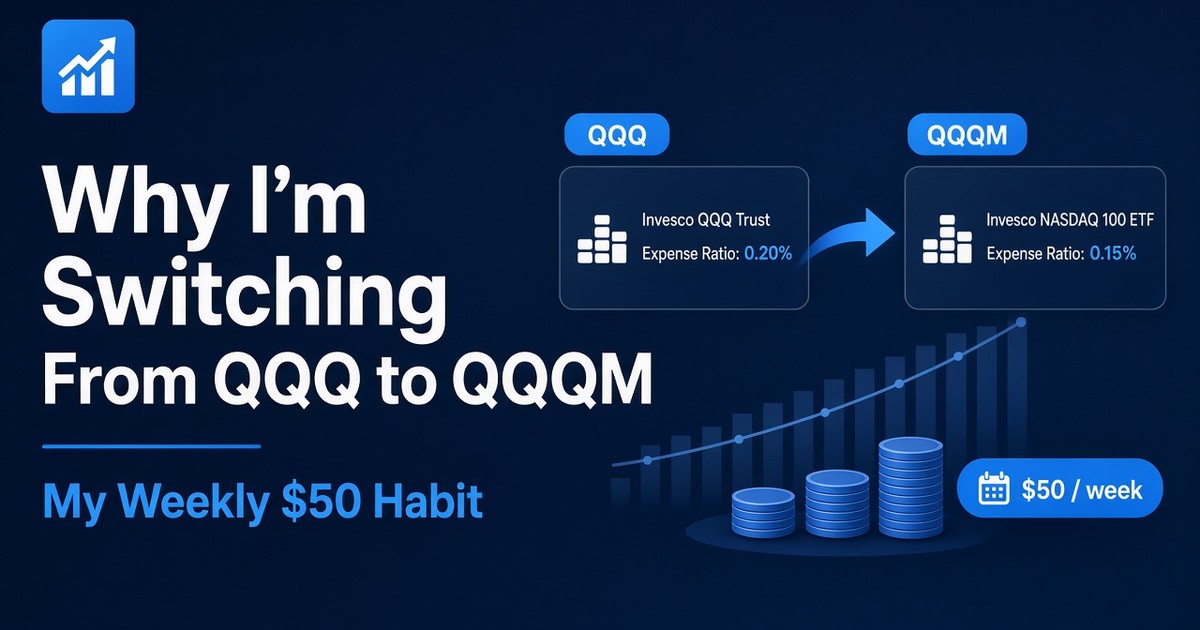
For a long time, that habit lived in QQQ — the Invesco QQQ Trust, the big, familiar ticker a lot of people mean when they say “Nasdaq ETF.”
Lately I’ve been moving that weekly $50 to QQQM — the Invesco NASDAQ 100 ETF — instead.
Not because I found a hotter fund.
Not because I’m “trading.”
Because for a buy-and-hold dollar-cost-averaging habit, same index + lower fee is the kind of quiet upgrade that compounds in the background
It’s mostly a question of which wrapper I want for the same exposure — especially when I’m adding small amounts every week.
(Fund details and expense ratios are published by Invesco; always check the latest prospectus / fact sheet before you act, because fees and structures can change.)
The fee gap is small — and that’s the point
Expense ratios (as of the research brief):
- QQQ: 0.18% (was 0.20% before a UIT → open-end reclassification after the close on December 19, 2025)
- QQQM: 0.15%
- Gap: 0.03% (3 basis points)
Optional scale check at a 3 bp gap: about $3/year on $10k, about $15/year on $50k.
That’s not “get rich from switching.” That’s stop leaking a little edge on a habit you already like.
“But QQQ is more liquid / more famous”
True — and still not the main issue for this use case.
QQQ is the giant on AUM and volume. For $50 weekly buys, both are generally fine, with tight spreads.
Share price (~Sep 15, 2026, ETFdb): QQQ around $709 vs QQQM around $292. With fractional shares (broker-dependent), share price isn’t the strategy — the habit is.
QQQ still wins if you need a deep options market. QQQ is now open-end too after late-2025 reclassification, so the live comparison is simpler: same index, QQQM’s lower ER.
When QQQM wins
- Buy-and-hold Nasdaq-100, not trading around it
- DCA — small repeated buys
- New weekly $50 → QQQM
- Existing QQQ → decide account-by-account (taxable vs tax-advantaged)
- In a taxable account with big gains, “switching” can mean new money to QQQM first, not blindly selling everything
- Fee drag matters more than brand over 10–20 years
- You don’t need QQQ’s options toolkit
How I’m handling the switch
The real reason this matters
The $50/week system only works if you keep doing it. Defaults should be: same exposure, lowest reasonable cost, no drama.
Same Nasdaq-100 story. Slightly cheaper chapter.
Want more “boring investing” breakdowns? Explore more guides on Help Your Finances, including our $50-a-week investing pieces — or join the newsletter for practical updates without the noise.
This article is for educational and informational purposes only. It is not financial, investment, tax, or legal advice. Expense ratios, share prices, fund structures, and tax rules can change. Verify current figures with Invesco, SEC filings, and your broker, and consider your own situation — including taxes — before making changes. If needed, consult a qualified professional.
When I’d still keep QQQ
- Need options or extreme liquidity on purpose
- Large taxable QQQ position where selling would realize gains you don’t want for 3 bp
- Broker/account makes one ticker easier to automate
Three basis points will not change your life this month.
Over a long weekly habit, it still matters — because you’re paying it on a growing pile, for years.
Fee math on $50/week (contributions only)
If you invest $50/week = $2,600/year, and we look at the fee difference on contributions alone (no market returns modeled):