If you’re in your twenties and feel like the game is rigged, you’re not imagining it. Rent eats your paycheck. Home prices look like phone numbers. And the one thing that still feels within reach is the $7 matcha that makes Tuesday a little better.
Then someone older tells you that’s why you’re broke. We made our coffee at home. We saved every dollar.
Let’s be honest about both sides, and then talk about what actually works.
Yes, it really is harder
This isn’t just a feeling. The numbers back it up:
- Homes cost about 5 times income. Harvard’s Joint Center for Housing Studies found the national median home price hit 5.0 times median household income in 2024, tying the record high. In the 1990s, that ratio averaged 3.2. In 2019 it was 4.1.
- The median existing single-family home sold for $412,500 in 2024, up $137,900 from 2019 (NAR data, via Harvard JCHS).
- First-time buyers are older and rarer. In NAR’s 2025 Profile of Home Buyers and Sellers, the median first-time buyer was 40 years old, a record. In the 1980s, the typical first-time buyer was in their late 20s. First-time buyers made up only 21% of all buyers, the lowest since NAR began tracking in 1981. Before 2008, it was about 40%.
So when your parents say “just save up and buy a house,” they bought a home that cost about three years of income. You’re looking at five, and much more in places like Los Angeles or San Jose.
That’s real. But “harder” isn’t the same as “hopeless.”
About that matcha
The little treat is not the problem. A $6 coffee will not decide whether you own a home.
Here’s what’s really going on: when the big goals feel impossible, small pleasures feel like the only win available. That’s human. The trap isn’t the coffee. The trap is believing the big goal is so far away that nothing you do today matters, so you put zero toward it.
So here’s our rule: the treat is fine, but pay future-you first. Move money to investing on payday, before you spend, and then enjoy what’s left without guilt.
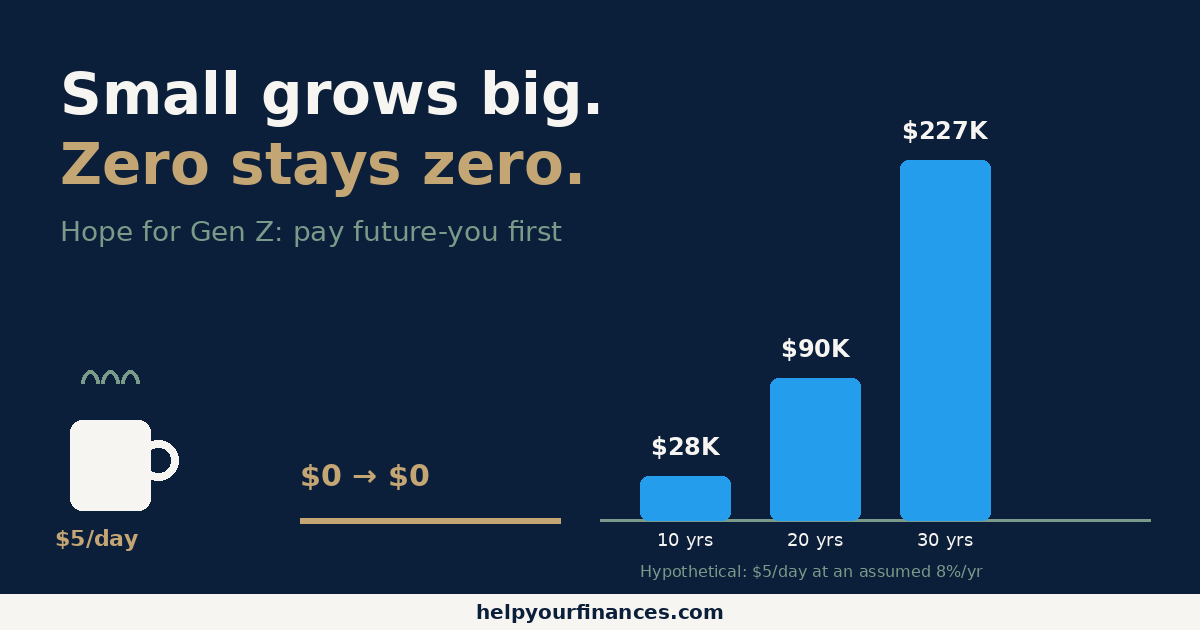
Small grows big. Zero grows to zero.
This is the whole idea in one line. Compounding doesn’t care how small you start. It only needs something to work with.
Here’s a hypothetical illustration: monthly contributions at an assumed 8% average annual return, compounded monthly. Real returns vary year to year, can be negative, and aren’t guaranteed. Taxes and fees are ignored.
| Contribution | After 10 years | After 20 years | After 30 years |
|---|---|---|---|
| $5 a day (~$152/mo) | $27,823 (put in $18,250) | $89,580 (put in $36,500) | $226,659 (put in $54,750) |
| $50 a week (~$217/mo) | $39,638 (put in $26,000) | $127,621 (put in $52,000) | $322,911 (put in $78,000) |
| $0 | $0 | $0 | $0 |
Look at the last row. Zero, compounded for 30 years, is still zero. Meanwhile, $50 a week, roughly one takeout meal, could grow to over $300,000 in this hypothetical.
I’ve lived a version of this myself. I started with $50 a week, and wrote about it in From a $50 Habit to ~$25K: Paying Myself First as a Beginner Investor. It didn’t feel like much at first. That’s the point. It doesn’t have to.
How to get ahead in this environment
- Start small, start now. $25 or $50 a week is enough. Time in the market is the ingredient you can never buy back later.
- Automate it. Set an automatic transfer on payday into a broad index fund. If you never see the money, you won’t miss it.
- Grab free money first. If your employer offers a 401(k) match, contribute at least enough to get the full match. It’s an instant return you won’t find anywhere else.
- Open a Roth IRA. You invest after-tax money now, and qualified withdrawals in retirement are tax-free. Early in your career, when your tax rate is likely lower, that’s a great deal.
- Raise it with every raise. Each time your pay goes up, bump your contribution by 1-2% before lifestyle creep finds it.
- Keep the treats, cut the leaks. Unused subscriptions and high-interest credit card balances cost far more than coffee.
Not sure what to invest in? Growth vs Dividend vs Covered Call ETFs: Which Fits a Beginner? walks through the basic options.
So, will Gen Z be able to buy a home like their parents?
Honest answer: many of you won’t buy the way your parents did, at 27, with a single income, in the city you grew up in. The data says first homes are coming later.
But owning a home is still possible. The path just looks different:
- House hacking. Buy a duplex or a home with extra rooms and rent part of it out. Your tenants help pay the mortgage.
- Start smaller or farther out. A condo, townhome, or a starter home in a lower-cost metro can be a stepping stone, not a forever home.
- Use first-time buyer programs. Many states and cities offer down payment assistance, and some loan programs allow low down payments.
- Let your investments build the bridge. NAR found that 26% of first-time buyers used financial assets like stocks or a 401(k) for their down payment. That small weekly habit can become part of your down payment.
- Rent without shame. Renting while you invest steadily isn’t failure. It’s a strategy, especially in very expensive markets.
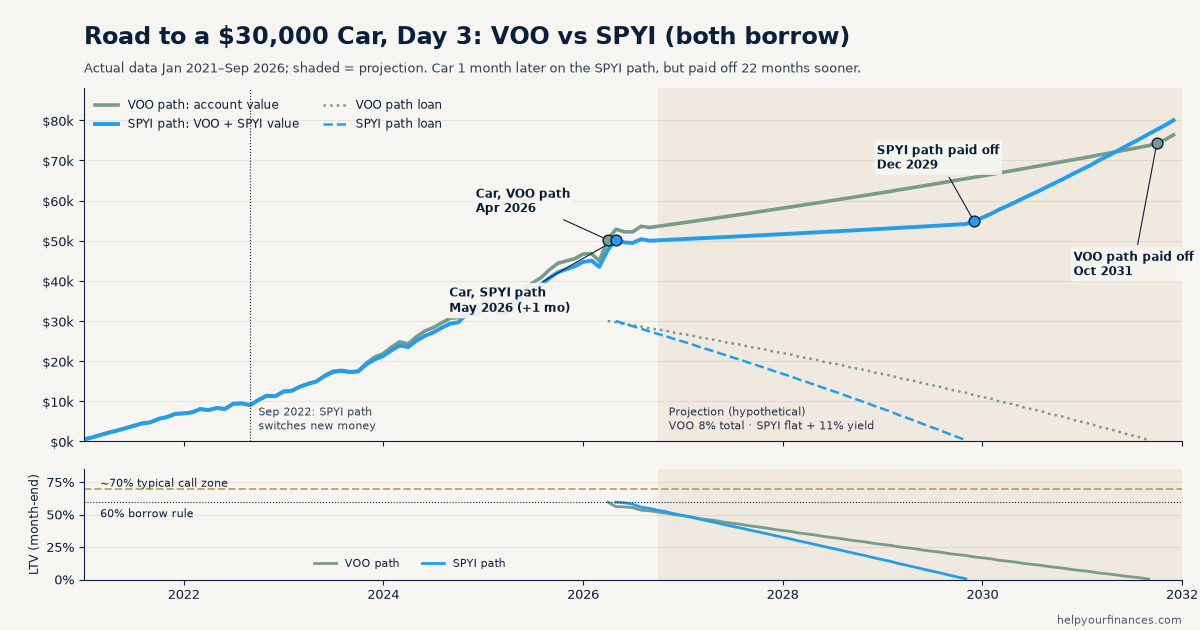
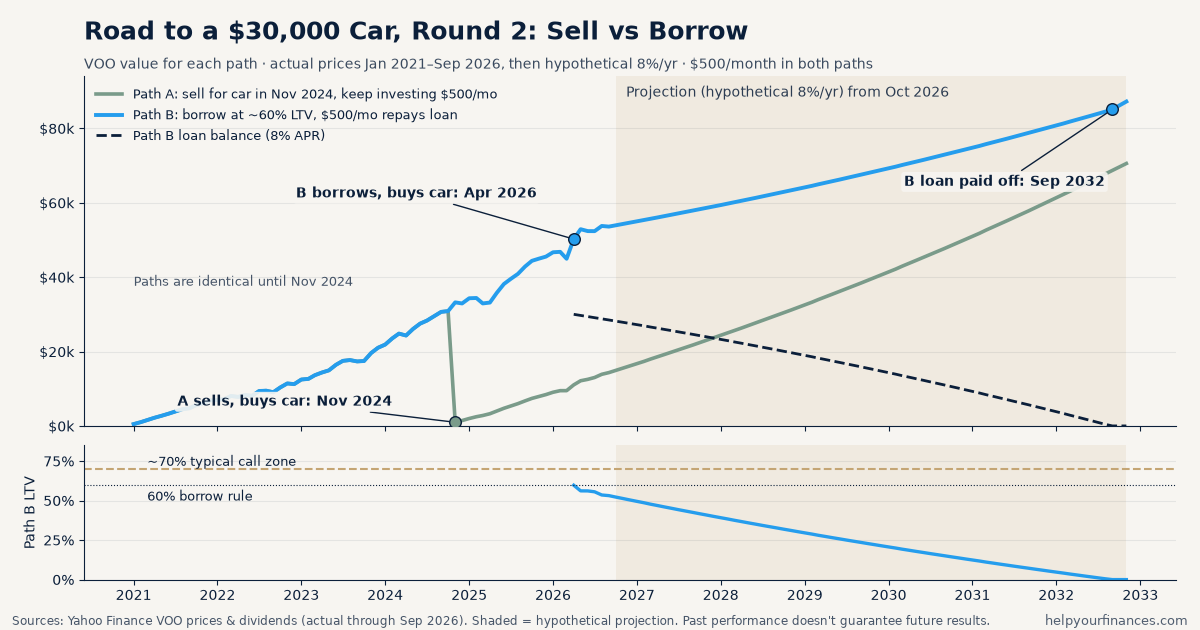
The same idea runs through our Road to a $30,000 Car series: money that keeps growing gives you options. Assets give you a head start on the next big goal. Zero gives you nothing to stand on.
The hope is in the habit
You can’t control home prices. You can’t control interest rates. You can control whether you put something to work for future-you this week.
Enjoy the matcha. Then pay yourself first. Small will grow big. Zero will grow to zero.
Educational only, not financial advice.
Sources
- Harvard Joint Center for Housing Studies, The State of the Nation’s Housing 2025 (price-to-income 5.0 in 2024, 3.2 in 1990s, 4.1 in 2019; median existing single-family price $412,500): https://www.jchs.harvard.edu/sites/default/files/reports/files/Harvard_JCHS_The_State_of_the_Nations_Housing_2025.pdf
- Harvard JCHS, “Home Prices Surge to Five Times Median Income” (Oct 6, 2025; metro ratios): https://www.jchs.harvard.edu/blog/home-prices-surge-five-times-median-income-nearing-historic-highs
- NAR, “First-Time Home Buyer Share Falls to Historic Low of 21%, Median Age Rises to 40” (Nov 4, 2025; 26% used financial assets): https://www.nar.realtor/press-releases/first-time-home-buyer-share-falls-to-historic-low-of-21-median-age-rises-to-40
- NAR, “NAR 2025 Profile of Home Buyers, Sellers Reveals Market Extremes” (lowest share since tracking began in 1981): https://www.nar.realtor/news/real-estate-news/nar-2025-profile-of-home-buyers-sellers-reveals-market-extremes
- NAR, 2025 Profile of Home Buyers and Sellers highlights (late-20s in 1980s; ~40% pre-2008 norm): https://www.nar.realtor/sites/default/files/2025-11/2025-profile-of-home-buyers-and-sellers-highlights-11-04-2025.pdf