Welcome back to the bracket. In Day 1, VOO beat a high-yield savings account to a $30,000 car. In Day 2, Alex stopped selling and started borrowing, and VOO (borrow) advanced on a split decision.
Today, Alex still borrows. The twist is what Alex owns while borrowing.
Round 3: VOO (borrow) vs. SPYI (borrow).
The twist: a fund that pays you to wait
SPYI is a covered-call ETF. It sells call options on the S&P 500 and passes the proceeds on as a big monthly distribution. In our model it pays about 11% a year in cash, but its price doesn’t grow. (More on covered-call funds in our covered-call ETF history and NAV guide and monthly income with covered-call ETFs.)
The idea is simple: if every distribution goes straight to the loan, the loan should shrink faster. The question is whether giving up VOO’s growth is worth it.
Here’s how the two Alexes differ:
- VOO path: Alex stays in VOO the whole way.
- SPYI path: SPYI didn’t exist when Alex started in January 2021. It began trading on August 30, 2022. So Alex starts in VOO, too, and from September 2022 puts new $500 purchases and reinvested distributions into SPYI. Alex keeps the VOO shares already owned. Nothing is sold, and no tax is triggered at the switch.
Both paths borrow under the same rule as Day 2, and both use their combined holdings (VOO + SPYI) to test the 60% LTV rule.
Quick answer
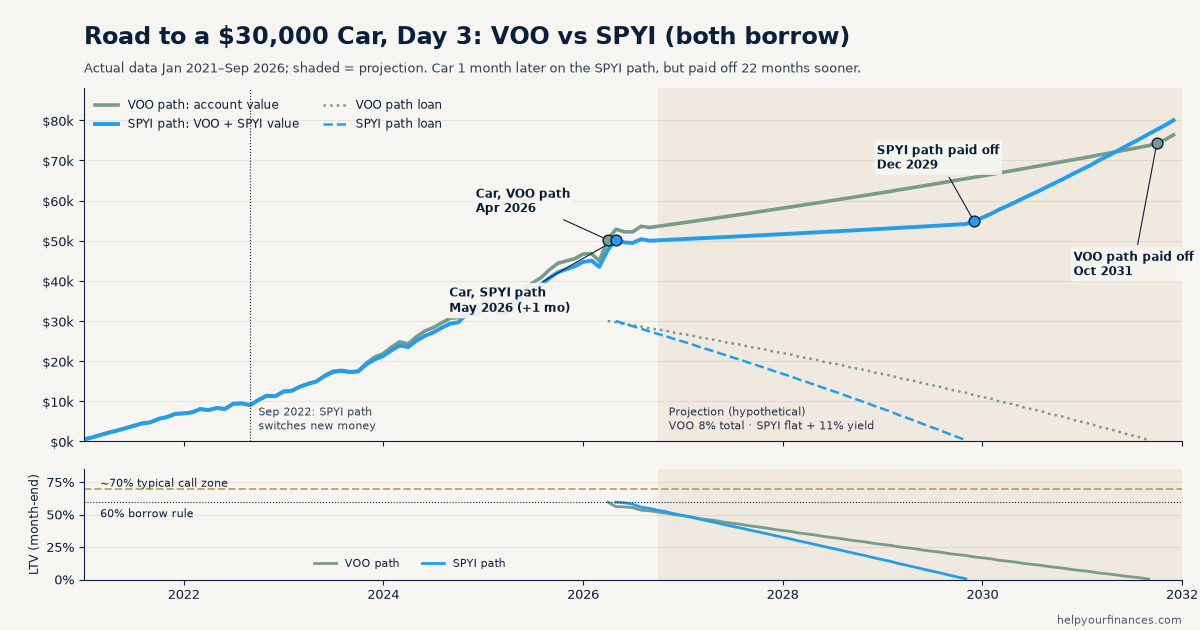
The VOO path gets the car 1 month sooner. It buys in April 2026; the SPYI path buys in May 2026. That’s not a tie, and we’re not going to pretend it is.
The SPYI path pays the loan off 22 months sooner. It’s done in December 2029. The VOO path is paid off in October 2031. The SPYI path also pays $2,685 less interest ($4,524 vs $7,209).
At the same date (October 2031), the SPYI path is ahead: $77,695 vs $74,299 before tax, and $73,475 vs $64,429 if Alex sold everything and paid the tax.
Under our two-part scoring rule, that’s a split decision. VOO wins speed to the car; SPYI wins on after-tax wealth. The bigger after-tax balance breaks the tie, so SPYI (borrow) advances.
Read this before you cheer for either side. Our real data covers only January 2021 to September 2026. Both loan payoffs, and every wealth number after that, come from a projection: VOO at 8% a year total return (1.3% yield), and SPYI with a flat price and an 11% yield. The SPYI assumption is ours. Covered-call funds can lose share value over time, and in the real data through September 2026, the VOO path was actually ahead ($53,287 vs $49,989 in the account). The SPYI path wins only because we assume its 11% payout beats VOO’s 8%. We show a stress case below.
The assumptions (read this first)
Assumptions box
- Both paths: start January 2021 with $500 into VOO on the 1st of each month. Actual VOO prices and dividends (Yahoo Finance), dividends reinvested, shares bought at the opening price on the first trading day of each month. The two paths are identical through August 2022.
- SPYI path switch (September 2022): new $500 purchases and all reinvested distributions (from VOO and SPYI) buy SPYI. Existing VOO shares are kept. No sale, no tax at the switch.
- Borrowing: at the first month-end when the combined account is worth at least $50,000 (so a $30,000 loan is 60% LTV or less), Alex borrows $30,000 at 8% a year (interest added monthly) and buys the car.
- Loan payments: after the car, $500 on the 1st of each month plus every distribution from both holdings goes to the loan. No new buying until it’s paid off.
- After payoff: $500 a month resumes buying: VOO in the VOO path, SPYI in the SPYI path. Distributions are reinvested into that same fund.
- Distribution tax is ignored in the main case. Sensitivities below use 24.3% and 31.3%. Capital gains tax (24.3% long-term, 31.3% short-term, oldest shares first) only shows up in the “after tax if sold” figures.
- Real data vs projection: actual data runs January 2021 through September 2026. From October 2026, VOO earns a hypothetical 8% a year total return (1.3% yield paid quarterly). SPYI earns a hypothetical 0% price return plus an 11% yield paid monthly. Planning assumptions, not forecasts.
- Same out-of-pocket money: Alex spends $500 every month in both paths. By October 2031, that’s $65,000 either way.
- No fees, a fixed 8% loan rate, and a car that stays at $30,000. Real securities-backed loans usually have variable rates.
Scoring rule recap
Since Day 2, each round is scored two ways:
- Outright win: one path gets the car first and isn’t behind on after-tax wealth at the end.
- Split decision: one path wins on speed, the other on wealth. The bigger after-tax balance breaks the tie. “After-tax” means what Alex would have if everything were sold and taxed, measured when both loans are paid off.
“Speed” here means getting the car. (The SPYI path also wins on payoff speed, but that shows up in the wealth contest.)
Round 3 results
Contest 1: Who gets the car first?
| VOO path | SPYI path | |
|---|---|---|
| Car purchase | April 2026 (month 64) | May 2026 (month 65) |
| Account value that month | $50,224 (all VOO) | $50,278 (VOO $18,146 + SPYI $32,132) |
| LTV when borrowing | 59.7% | 59.7% |
| Wait vs VOO path | — | 1 month longer |
Both car purchases happen in real data.
Contest 2: The loan
| VOO path | SPYI path | |
|---|---|---|
| Loan paid off | October 2031 (66 months after borrowing) | December 2029 (43 months after borrowing) |
| Total interest | $7,209 | $4,524 |
| Distributions applied to the loan | $4,412 | $13,210 |
| Share of repayments covered by distributions | about 12% | about 38% |
| Peak month-end LTV after borrowing | 59.7% | 59.7% |
| Peak daily LTV (real data) | 59.2% (May 4, 2026) | 61.4% (Jun 10, 2026) |
Both payoff dates are in the projection period (hypothetical).
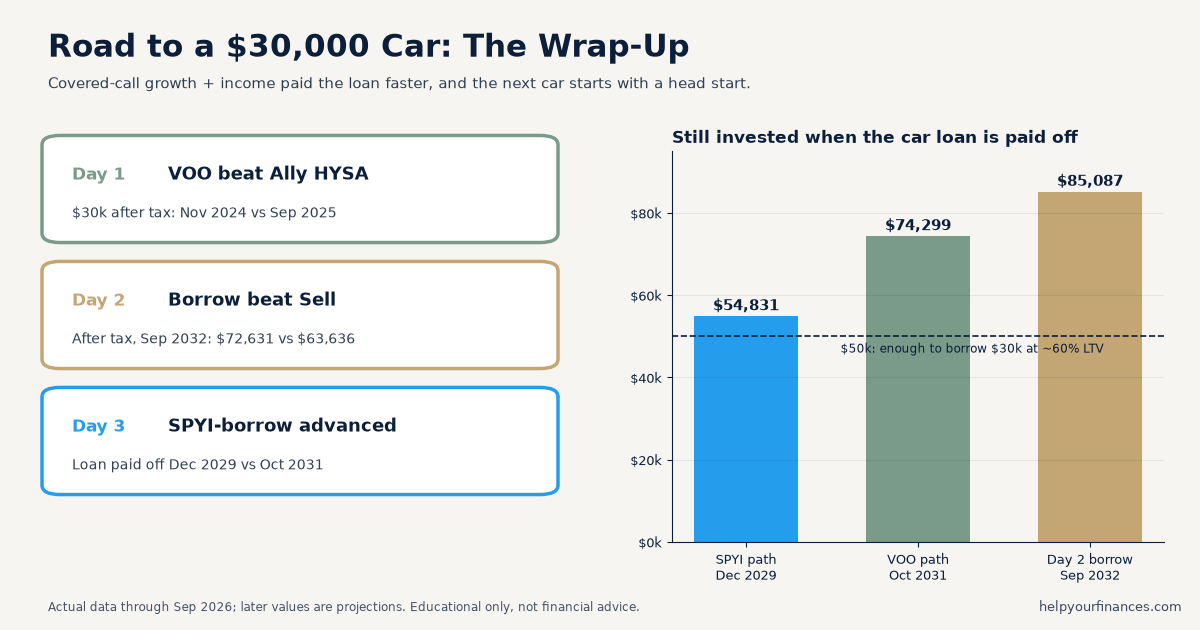
The balance of the assets when each car is paid off
Alex asked: what’s actually left when the loan is gone? Here it is, for each path at its own payoff date.
At each path’s own payoff (hypothetical, projection period)
| VOO path, Oct 2031 | SPYI path, Dec 2029 | |
|---|---|---|
| VOO holdings | $74,299 | $22,576 (41%) |
| SPYI holdings | — | $32,254 (59%) |
| Total account value (pre-tax) | $74,299 | $54,831 |
| Loan balance | $0 | $0 |
| Total out of pocket by then | $65,000 | $54,000 |
| Cost basis | $33,682 | $40,315 |
| Unrealized gain | $40,617 | $14,515 |
| Tax if Alex sold everything | $9,870 | $3,527 |
| After-tax value if sold | $64,429 | $51,303 |
| Total interest paid | $7,209 | $4,524 |
These two columns are different dates, so don’t compare them head to head. The SPYI path simply gets there 22 months earlier, having put in $11,000 less.
On the same date: December 2029 (the day the SPYI loan is gone), the VOO path still owes $11,499:
| December 2029 | VOO path | SPYI path |
|---|---|---|
| Account value | $65,789 | $54,831 |
| Loan still owed | $11,499 | $0 |
| Account minus loan (pre-tax) | $54,290 | $54,831 |
| After-tax value if sold, minus loan | $46,438 | $51,303 |
On the same date: October 2031 (the later payoff). From December 2029, the SPYI path has resumed $500 a month into SPYI for 22 months:
| October 2031 | VOO path | SPYI path |
|---|---|---|
| VOO holdings | $74,299 | $25,426 (33%) |
| SPYI holdings | — | $52,269 (67%) |
| Total account value (pre-tax) | $74,299 | $77,695 |
| Total out of pocket | $65,000 | $65,000 |
| Cost basis | $33,682 | $60,329 |
| Tax if Alex sold everything | $9,870 | $4,220 |
| After-tax value if sold | $64,429 | $73,475 |
The SPYI path leads by $3,396 pre-tax and $9,046 after tax. Most of that after-tax gap is because the SPYI path’s account has a much higher cost basis ($60,329 vs $33,682), so less of it is taxable gain. That brings us to an important caveat.
A tax caution about SPYI. Part of a covered-call fund’s distributions can be return of capital, which isn’t taxed when you receive it but lowers your cost basis. Our model treats reinvested SPYI distributions as adding to basis, and ignores tax on distributions in the main case. A lower real basis would mean a bigger taxable gain when you sell. So the SPYI after-tax figure is probably too flattering, not too conservative. Treat the $9,046 after-tax edge as an upper estimate, and ask a tax pro how your fund’s distributions are treated.
The timeline: how each path played out
January 2021 to August 2022: the same road. Both paths put $500 a month into VOO and ride out the 2022 drop. By August 2022, each account is worth $9,475.
September 2022: the SPYI path switches. New money and reinvested dividends go to SPYI. The VOO shares stay put.
November 2024. The VOO path has $33,211 in VOO. The SPYI path has $31,685 (VOO $14,440 + SPYI $17,245). The real data shows VOO growing faster than a covered-call fund in a rising market. That’s the usual trade: you get cash now, and give up some growth.
March 2026: not yet. Borrowing would mean 66.8% LTV on the VOO path ($44,935 account) and 69.0% on the SPYI path ($43,481). Both too high.
April 2026: VOO gets there first. The VOO path hits $50,224, so $30,000 is 59.7%. Alex borrows and buys the car. The SPYI path is at $47,669 (62.9% LTV): so close, but not yet.
May 2026: the SPYI path catches up. The account reaches $50,278 and Alex borrows at 59.7%. One month behind.
June 2026: a scare on the SPYI path. More on this in the risk section below.
September 2026: the last month of real data.
| September 2026 (real) | VOO path | SPYI path |
|---|---|---|
| Account | $53,287 | $49,989 (VOO $18,286 + SPYI $31,703) |
| Loan | $28,189 | $27,401 |
| LTV | 52.9% | 54.8% |
| Account minus loan | $25,098 | $22,587 |
So far, in real money, VOO is ahead. From here on, we’re in the projection.
December 2029: the SPYI path is debt-free. Distributions of about $360 to $370 a month, plus the $500 payment, have cleared the loan 43 months after borrowing. Total interest: $4,524.
October 2031: the VOO path is debt-free. VOO’s dividends are small (1.3% a year), so almost all of the work comes from the monthly $500. It takes 66 months and $7,209 in interest.
Why the SPYI path wins in the model (and the catch)
Both paths spend the same $500 a month. The difference is what the investments pay while the loan is open.
- SPYI pays more cash. At an 11% yield, the SPYI path sent $13,210 to the loan. VOO’s 1.3% yield sent $4,412. Every dollar sent to an 8% loan is an 8% guaranteed return.
- A smaller loan means less interest. Faster paydown cuts the interest bill by $2,685.
- Once the loan is gone, SPYI’s cash keeps getting reinvested (in our model).
The catch: this works only if SPYI’s total return, price change plus yield, stays higher than VOO’s 8%. We assumed 11% (flat price, 11% yield). That’s the user’s assumption, not a promise. If SPYI’s share price drifts down, the whole edge shrinks.
The stress test. What if SPYI’s price falls 3% a year while VOO earns only 6%? The car dates don’t change (they’re in real data). The payoffs move to November 2031 (VOO path) and January 2030 (SPYI path). At November 2031, both have put in $65,500:
| Stress case, Nov 2031 | VOO path | SPYI path |
|---|---|---|
| Account value | $68,025 | $69,497 |
| After-tax value if sold | $59,743 | $67,077 |
The SPYI path still leads, but before tax the lead is only $1,472. With a return-of-capital basis hit, that could shrink more.
Taxes on distributions. If Alex paid tax on the distributions sent to the loan, payoffs would slip:
| Distribution tax rate | VOO path payoff | SPYI path payoff |
|---|---|---|
| None (main case) | Oct 2031 | Dec 2029 |
| 24.3% | Dec 2031 | May 2030 |
| 31.3% | Jan 2032 | Jul 2030 |
The SPYI path takes the bigger hit (it sends more distributions to the loan, 5 to 7 months later, vs 2 to 3 months for VOO), but still pays off first in every case.
Variant: sell all the VOO at the switch. What if the SPYI path sold every VOO share in September 2022 and moved everything into SPYI? There’d be no tax, because VOO was under water then ($9,177 vs a $10,500 cost). In that case the car comes 4 months later than VOO’s (August 2026), but the loan is paid off in August 2029 with $3,758 in interest and $16,013 of distributions applied. At October 2031, the account would be $78,745 ($77,963 after tax). It’s a bigger bet on SPYI, and it only avoids tax because of where the market was that month. The main case keeps the VOO shares.
LTV and margin calls: the June 2026 scare
LTV (loan-to-value) is the loan divided by your account’s value. As we covered in Day 2, if the market drops, your account shrinks but the loan doesn’t, so LTV climbs. Past a lender’s limit (often around 70%, but it varies), you get a margin call. For a deeper look, see The Truth About Margin Investing: Risk, Reward, and Reality.
Here’s what the real data shows:
- VOO path: the peak LTV after borrowing was 59.7% (the day Alex borrowed). The highest daily reading afterward was 59.2% on May 4, 2026.
- SPYI path: the month-end peak was also 59.7%, but on June 10, 2026 the daily reading hit 61.4%: the loan was $29,700 against an account of about $48,409. The account dipped in early June while the loan was still near its starting size. By June’s month-end, LTV was back to 59.2%.
That reading is still about 9 points below a 70% call zone, so no margin call. But it shows something worth knowing: you can borrow at 59.7% and be over 60% a few weeks later. A buffer matters. And a covered-call fund’s price can swing with the market while its upside is capped, so “high income” doesn’t mean “safe.”
After that, LTV falls in the projection: the SPYI path drops under 50% by January 2027 and under 20% by October 2028. The VOO path drops under 50% by December 2026 and under 20% by October 2029.
The verdict: a split decision, and SPYI advances
- Speed to the car goes to VOO. April 2026 vs May 2026: 1 month sooner. Small, but real.
- Wealth goes to SPYI. At the later payoff (October 2031), the SPYI path is ahead by $3,396 before tax and $9,046 after tax (probably overstated; see the return-of-capital note). It also pays off the loan 22 months sooner with $2,685 less interest.
That’s a split decision. The bigger after-tax balance breaks the tie, so SPYI (borrow) advances.
Honest summary: in real history through September 2026, VOO was ahead. The SPYI path wins in the projection because we assumed an 11% payout that beats VOO’s 8%, and because SPYI’s cash was used to attack an 8% loan. Under a harsher assumption (SPYI price -3% a year, VOO 6%), it still led, but narrowly before tax. If you take away one thing, let it be this: income funds can help pay down a loan faster, but only if the fund holds its value.
Coming up: the bracket and the finale
- Day 1: HYSA vs VOO (sell) → VOO (sell) advances
- Day 2: VOO (sell) vs VOO (borrow) → VOO (borrow) advances (split decision)
- Day 3: VOO (borrow) vs SPYI (borrow) → SPYI (borrow) advances (split decision)
- Finale: the SPYI path takes on whatever is left of the bracket. We’re not announcing a result for it yet.
- Optional bonus round: a $250 VOO / $250 SPYI split. We haven’t run it, so there are no numbers yet.
FAQ
Can a covered-call ETF’s income really pay off a loan faster?
It can, if the cash is high and the fund holds its price. In our model, SPYI’s distributions covered about 38% of the loan repayments vs about 12% for VOO. But the yield was a hypothetical 11%, and a falling share price can wipe out the benefit.
How are SPYI distributions taxed?
It depends on the fund and the year. Distributions can be a mix of ordinary income, qualified dividends, and return of capital. Return of capital lowers your cost basis, which raises your taxable gain when you sell. We ignored distribution tax in the main case and show 24.3% and 31.3% sensitivities. Your fund’s year-end tax statement is what counts.
What happens if SPYI’s price falls after I borrow?
Your account shrinks, but the loan doesn’t, so your LTV rises. In our real data, the SPYI path’s LTV briefly hit 61.4% in June 2026. A drop of roughly 15% from the day Alex borrowed would be enough to reach a typical 70% call zone. Lenders set their own limits, and they may treat different funds differently, so ask yours.
Is it smart to borrow against stocks for a car at all?
It depends on your income, your cushion, and your tolerance for risk. Loan interest on a personal car isn’t tax-deductible. Rates can be variable. And a forced sale in a downturn can lock in losses and taxes. Alex’s rules (60% LTV, steady payments, no selling) were designed to avoid that.
Disclaimer: This article is for educational purposes only and isn’t financial, tax, or investment advice. Results use actual VOO and SPYI prices and distributions from Yahoo Finance through September 2026, and hypothetical returns after that (VOO 8% a year total return; SPYI flat price with an 11% yield), which are not predictions. Covered-call funds can lose share value, and their distributions may include return of capital. The loan terms (8% fixed, borrowing at 60% LTV) are simplified assumptions. Real securities-backed loans have variable rates, lender-specific limits, and margin call rules. Tax rates are simplified, and SPYI’s after-tax figures are likely overstated. Past performance doesn’t guarantee future results. Talk to a qualified professional about your own situation.