Meet Alex. It’s January 2021. Alex earns about $100,000 a year, lives in California, and wants a new car. Not a car loan or a lease. A $30,000 car, paid in cash, with money that’s already been taxed.
Alex’s plan is simple: put away $500 on the 1st of every month and see which strategy gets to $30,000 after tax fastest.
We’re running this like a bracket. Each day, two strategies go head to head, and the winner moves on. And this time, we’re not guessing. We used what actually happened: real savings rates and real VOO prices from January 2021 onward.
Round 1: High-yield savings account (HYSA) vs. VOO.
Quick answer
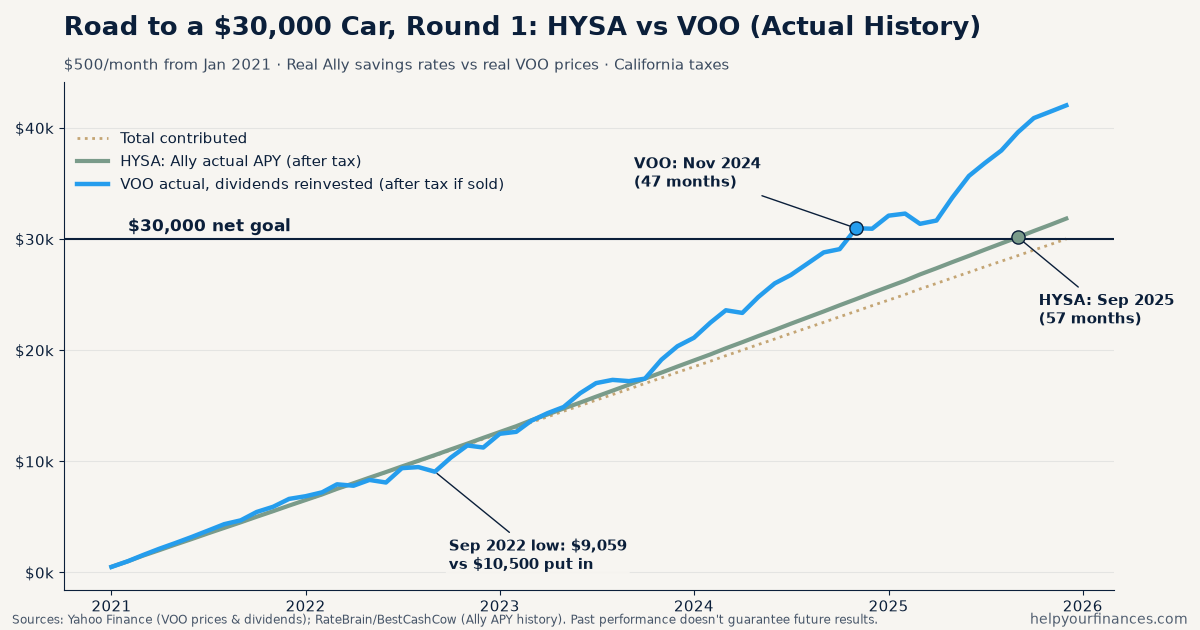
On real history, VOO wins Round 1. Alex reaches $30,000 net after tax in November 2024 (47 months) by investing in VOO and selling the shares. The high-yield savings account gets there in September 2025 (57 months).
That’s 10 months faster and $5,000 less of Alex’s own money. But the ride wasn’t smooth. In 2022, VOO spent 11 straight months worth less than what Alex had put in. If Alex had needed the car then, the savings account would have been the clear winner. More on that below.
The assumptions (read this first)
Assumptions box
- Start: January 2021. $500 deposited on the 1st of each month. Balances are checked at the end of each month.
- HYSA: we used Ally Bank’s online savings account as a stand-in for a typical big online bank, with its actual rate changes. It paid 0.50% APY all of 2021, started rising in May 2022, peaked at 4.35% in December 2023, and was down to 3.50% by September 2025. (Some banks paid more, some paid less.) Interest is taxed as ordinary income at 31.3% (22% federal + 9.3% California), and the tax is taken out of the account each December.
- VOO: actual daily prices and dividends. Each $500 buys VOO at the opening price on the first trading day of the month (fractional shares allowed). Dividends are reinvested. Values use the month-end closing price.
- Dividend taxes: in real life, VOO’s dividends get taxed every year. We don’t take that out in the main numbers. We checked: adding it back doesn’t change the winning month.
- Selling VOO: taxed lot by lot, oldest shares first (FIFO). Shares held more than a year pay 24.3% on the gain (15% federal long-term + 9.3% California). Shares held a year or less pay 31.3%.
- No fees, no inflation, and the car price stays at $30,000. (In reality, car prices jumped a lot in 2021–2023.)
- Winner rule: fastest to $30,000 net. If it’s a tie on months, the winner is whoever contributed less.
- Where the data comes from: VOO prices and dividends come from Yahoo Finance’s daily price history. Ally’s rate history comes from RateBrain’s record of Ally rate changes, cross-checked against rate-change reports from BestCashCow and Money.com.
Round 1 results
| HYSA (Ally, actual rates) | VOO (actual returns) | |
|---|---|---|
| Goal reached | September 2025 | November 2024 |
| Months taken | 57 | 47 |
| Total contributed | $28,500 | $23,500 |
| Balance before final tax | $30,387 | $33,211 |
| Taxes | $753 | $2,247 |
| Net after tax | $30,155 | $30,964 |
| “The market did the work” (net minus contributions) | $1,655 | $7,464 |
HYSA taxes: $521 taken out of the account from 2021 to 2024, plus $232 owed on 2025 interest. VOO taxes: what Alex owes on selling the shares.
How the HYSA got there
The HYSA is the steady, boring option, and that’s a compliment. The balance never drops.
But real savings rates were a tale of two halves. When Alex started, the rate was just 0.50%. Here’s how much interest the account earned each year:
- 2021: $16
- 2022: $139
- 2023: $603
- 2024: $907
Rates finally got good in 2023 and 2024, when Ally paid between 3.3% and 4.35%. By September 2025, the account had earned $2,409 in interest, and $753 of that went to taxes. At a 31.3% tax rate, a 4% APY really pays about 2.75%.
So Alex’s paychecks did most of the work: $28,500 in, with interest covering the last $1,655.
What if Alex paid the tax from their checking account instead? Then the full interest stays in the account and keeps compounding. Alex gets there one month sooner, in August 2025 (56 months), with $28,000 contributed. But that’s not free. Alex also paid about $525 in taxes from outside cash through 2024 (plus about $210 owed on 2025 interest). Either way, the HYSA still finishes well behind VOO.
How VOO got there: the real ride
VOO didn’t go up in a straight line. Here’s how Alex’s account actually went.
2021: a smooth start. Stocks had a great year. By December 2021, Alex had put in $6,000, and it was worth $6,867.
2022: the gut check. Then the market fell. In September 2022, Alex had put in $10,500, but the account was worth only $9,059. That’s about 14% under water. From April 2022 through February 2023, VOO was worth less than Alex’s contributions at the end of 11 months in a row. That whole time, the boring savings account was ahead.
2023–24: the comeback. Alex kept buying $500 a month at those lower prices. Then the market roared back. VOO closed September 2022 at $328.30 and November 2024 at $553.45. By the end of 2023, the account was worth $21,018 on $18,000 contributed.
October 2024: so close. Alex’s shares were worth $30,867, but after $1,783 of tax, Alex would have netted only $29,084. About $900 short.
November 2024: goal. The shares were worth $33,211 on $23,500 contributed. Alex had about $7,966 of long-term gains, taxed at 24.3%, and $994 of short-term gains on the most recent year of purchases, taxed at 31.3%. Total tax: $2,247. That leaves $30,964 net. Enough for the car.
Over that stretch, VOO returned about 14.5% a year with dividends reinvested (up 69.7% in total from January 2021 to November 2024). That’s well above the long-run average.
Three quick notes:
- Alex doesn’t have to sell everything. To net exactly $30,000, Alex would sell about $32,232 of shares and leave roughly $979 invested.
- The simple shortcut works here, too. If you just tax all of Alex’s growth at 24.3%, the result still lands in November 2024.
- Dividend taxes don’t change the answer. If Alex paid tax on dividends each year, from checking or out of the dividends themselves, VOO still hits the goal in November 2024. Even with no dividends at all, it gets there that month, just barely, with $30,038 net.
And right after the finish line, a reminder. In April 2025, tariff news sent stocks sharply lower. If Alex had kept the money invested instead of buying the car, the account would have dropped to about $29,046 after tax at the close on April 8, 2025. That’s back under the goal. By the end of April it had recovered to $31,656, but nobody knew that would happen at the time. Once you hit your number for a must-buy goal, take it.
What the 8% planning assumption would have said: May 2025
Our first version of this article assumed VOO grew a smooth 8% a year. That predicts Alex hits $30,000 net in May 2025 (53 months, $26,500 contributed).
Real life got there six months sooner, because 2021, 2023, and 2024 were unusually strong years. That doesn’t mean 8% is a bad planning number. It means this particular stretch was a good one. The next five years could just as easily come in under 8%.
The real lesson from 2022: timing matters
Here’s the honest part. Suppose Alex had needed the car sooner and planned to buy it in late 2022:
| Month | Contributed | VOO value | HYSA net |
|---|---|---|---|
| June 2022 | $9,000 | $8,088 | $9,026 |
| September 2022 | $10,500 | $9,059 | $10,554 |
| December 2022 | $12,000 | $11,235 | $12,107 |
In every one of those months, VOO was worth less than Alex put in, and the savings account was ahead. A buyer in late 2022 would have had two bad choices: sell at a loss, or wait.
VOO won this race because Alex could wait, and because the market recovered while Alex was still saving. The market doesn’t care when your car shopping starts.
The verdict: VOO advances, but with an asterisk
Winner: VOO, by 10 months and $5,000 less contributed, on real 2021–2024 history.
To be fair:
- The HYSA is guaranteed (as long as you stay within FDIC or NCUA limits). It never lost a dollar, and it led the race through most of 2022. The trade-off is that it’s slower, and real savings rates were close to zero for the first year and a half.
- VOO was faster this time, but nothing is guaranteed. Alex needed the stomach to watch the account sit under water for 11 months, and the luck that the recovery came before the purchase date.
A common middle ground: invest for the car while the goal is years away, then move money into savings as the purchase date gets closer. We dig into the bigger picture in How to Pay for Your Next Car Without Wrecking Wealth.
Coming up on Day 2: what if Alex never sells?
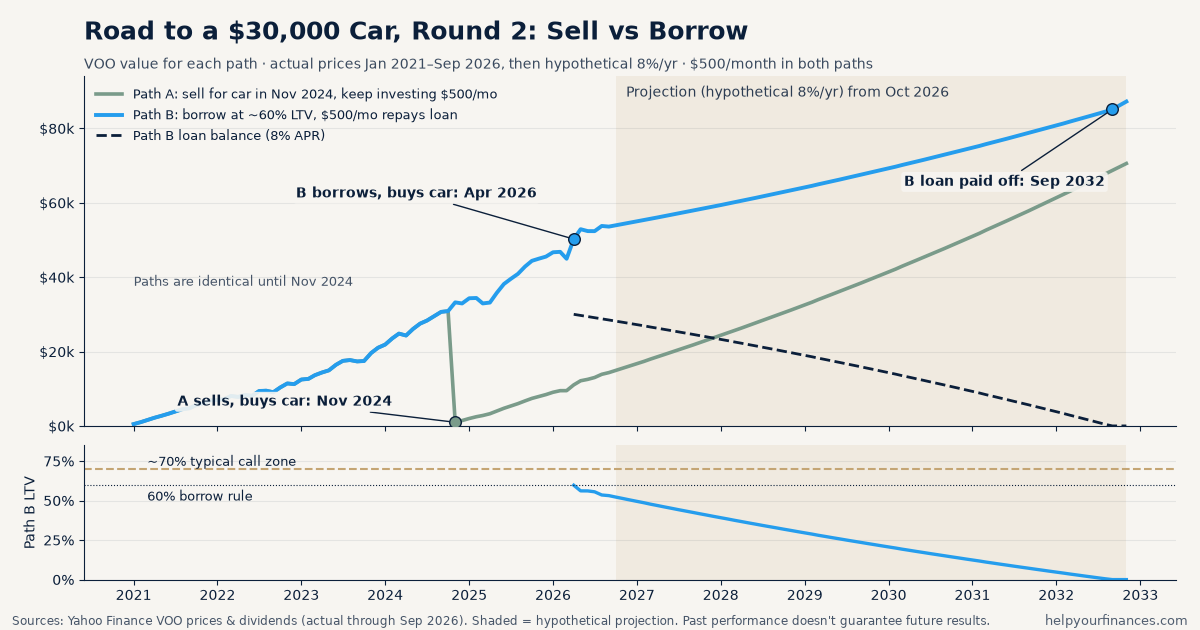
VOO won even after paying $2,247 in tax on the sale. So what if Alex didn’t sell at all?
On Day 2, VOO (sell) faces VOO (borrow). Alex keeps the shares and takes out a securities-backed line of credit or margin loan to buy the car. No sale means no capital gains tax right away. But Alex pays interest, and a market drop (like April 2025) could lead to a margin call. (If you want a head start, read The Truth About Margin Investing.)
The bracket:
- Day 1: HYSA vs VOO (sell) → VOO advances
- Day 2: VOO (sell) vs VOO (borrow)
- Day 3: Day 2 winner vs SPYI (borrow)
- Bonus round: a $250 VOO / $250 SPYI split
FAQ
Is 14.5% a year normal for VOO?
No. That’s what VOO happened to deliver from January 2021 to November 2024, including a down year in 2022. Many people plan with something like 8% a year as a long-run average, and that’s still an average, not a promise. Any five-year stretch can land well above or below it.
Why does the HYSA lose so much to taxes?
HYSA interest is ordinary income, taxed at your full rate every year even if you never withdraw it. At 31.3%, a 4% APY nets about 2.75%. Long-term stock gains get a lower federal rate, and you pay only when you sell.
Should I invest money I need for a car in 4–5 years?
It depends on how flexible your timeline is. If the car must be bought on a certain date, savings protect you from bad timing, like late 2022. If you can wait out a downturn, investing offers more growth potential, with real risk. For more on making money work for you, see Passive Income Explained.
Disclaimer: This article is for educational purposes only and isn’t financial, tax, or investment advice. Results use historical VOO prices and dividends (Yahoo Finance) and Ally Bank’s historical savings rates (RateBrain, BestCashCow, Money.com), with simplified assumptions: no fees, fractional shares, and simplified tax rates. Ally is used as one example of an online savings account, and other banks paid different rates. Past performance doesn’t guarantee future results. Talk to a qualified professional about your own situation.