A year ago — September 16, 2025 — I wrote Why Smart Investors Welcome Market Downturns.
The thesis was simple: when you’re new, a red day feels like your money disappearing. With time, conviction, and a portfolio built mostly on broad ETFs, a dip starts to look like a sale — a chance to buy more of what you already believed in.
So… did that hold up?
Short answer: Yes. The twelve months after that piece were not a straight line up — and the last couple of weeks of AI / chip / big-tech weakness are a live test of the same idea. If you stayed invested in the boring building blocks (think VOO, QQQM, SCHD), the year still worked in your favor. Panic would have been the expensive choice.
This is a follow-up scorecard and mindset check — educational only, not advice.
Quick scorecard: ~12 months since that article
Hard numbers below are total return (dividends reinvested) from Tue Sep 16, 2025 → Mon Nov 2, 2026, via Total Real Returns (inflation off). Past performance ≠ future results.
| ETF | Total return that window | $10,000 grew to |
|---|---|---|
| VOO | +15.57% | $11,557 |
| QQQ | +15.88% | $11,588 |
| QQQM | +15.95% | $11,595 |
| SCHD | +36.82% | $13,682 |
That’s the scorecard in one glance: if you stayed invested from the day the original article published through early November 2026, the calm ETF sleeves were still ahead — even after the late-October AI/chip washout.
It wasn’t a straight line. Inside that same window (TRR drawdowns):
- March 30, 2026: QQQ/QQQM were about −11.96% off a late-Oct 2025 peak; VOO about −8.90% off a late-Jan 2026 peak.
- Oct 6 → Nov 2, 2026: QQQ about −10.34% / QQQM about −10.32% / VOO about −3.47% from the Oct 6 peak; SCHD held up (no current drawdown in that TRR view). SCHD’s worst dip in the full window was about −6.88%.
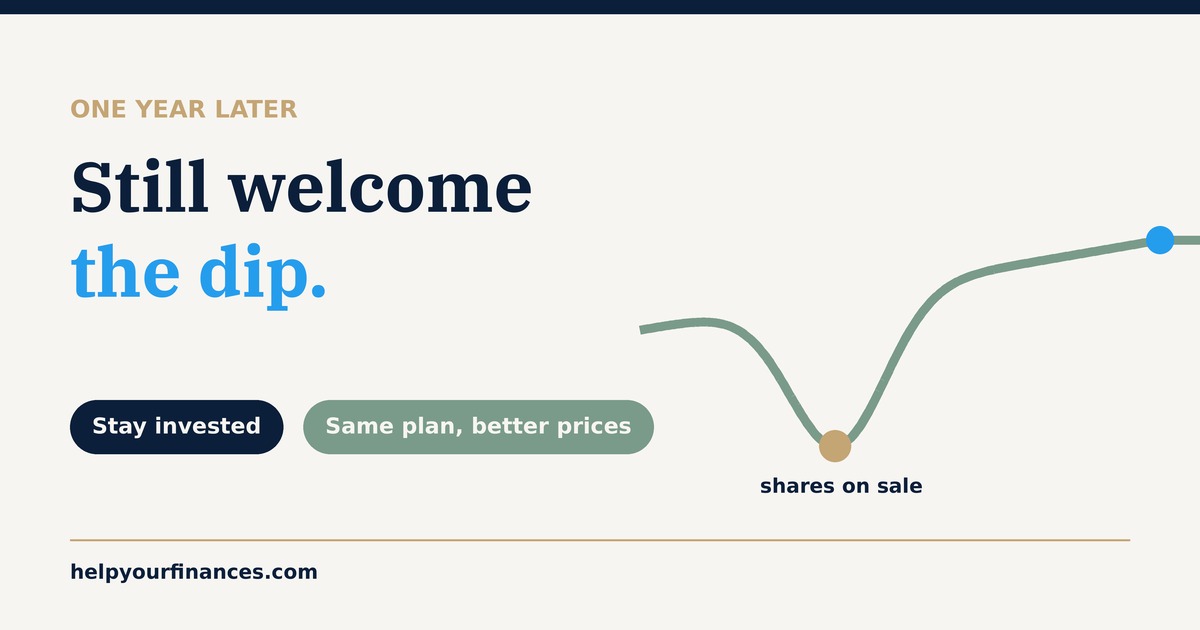
If you welcomed dips as “shares on sale” and kept buying your plan — that year rewarded the boring behavior the original piece argued for.
If every red candle felt like a reason to jump ship — this was another expensive reminder that the market’s long-term upward grind includes months that feel personal.
What the original piece got right (and still gets right)
Three turning points from that article still matter more than any headline:
1. Milestones change how a 10% swing feels
Crossing meaningful portfolio milestones (I talked about $100k) doesn’t make you immune to fear. It makes the math real. A 10% dip isn’t an abstract chart — it’s a chunk of dollars. The healthy response isn’t numbness. It’s: same plan, better prices for new contributions.
2. Conviction beats hot tips
Dabbling in whatever’s loud makes every downturn feel like proof you picked wrong. Conviction in long-term index ETFs flips the script: a dip is temporary pricing on assets you intended to own for decades.
3. ETFs over single-stock drama
A single company can have a nightmare week. A broad ETF spreads that pain. That’s why I keep pointing people toward sleeves like VOO (plain S&P), QQQM (Nasdaq-100, lower-fee cousin of QQQ — why I prefer QQQM for weekly buys), and SCHD (quality dividends) — calm building blocks, not lottery tickets.
One honesty label for this year’s test: Nasdaq-100 isn’t “the whole market.” It’s growth- and tech-heavy — which is exactly why QQQ/QQQM felt the AI/chip dive harder than VOO or SCHD. Diversification across companies isn’t the same as diversification across styles.
Downturns are still a gift if you’re a buyer with a job, a plan, and dry powder. They’re a tax on impatience if you’re forced to sell.
The live test: AI chips and tech took a dive
Over the past couple of weeks into late October / early November 2026, the “AI forever, only up” mood got a cold shower. The pressure started building mid-month (chip/AI financing worries and a rough week for semis around mid-October) and crescendoed into the late-October earnings washout.
What hit the tape (sourced public reports):
- October 30, 2026 (AP): S&P −1.8% (worst day since June); Nasdaq −2.9%; Dow −1.1%. NVDA −4.2%; AMD −10.9%; Intel −28.6%. Nasdaq was about −7.8% from its Oct 6 all-time high in contemporaneous reporting; the broader chips complex was roughly −7% that day and >15% for the month.
- October 2026 chip ETFs (Benzinga): SOXX −17.1% · SMH −14.2% · XSD −14.6% for the month. On Oct 30 alone: SOXX −8.24%, SMH −6.98%. NVDA was down more than 10% for October; AMD about −17.5%.
- From the Oct 6 peak through Nov 2 (TRR): QQQ −10.34% / QQQM −10.32% while VOO was only about −3.47% — and SCHD held its ground in that view. Growth felt the dive; the broader plan didn’t have to.
The story under the story wasn’t “AI is fake.” It was investors arguing about cash burn vs returns, hyperscaler AI spend, chip outlooks, and whether prices had run ahead of proof.
That’s a classic growth-stock hangover — not a reason to throw away a diversified ETF plan.
What not to do in a tech dive
- Don’t panic-sell VOO/QQQM because NVDA had a bad week. Broad funds already price in the pain and the survivors.
- Don’t rotate into the loudest yield just to “feel safe.” That’s how people wander into high-yield traps when fear is loud.
- Don’t pretend single-stock heroics. If one chip name is 40% of your net worth, the problem isn’t the dip — it’s the concentration. The original article’s ETF shift was the fix.
What to do (HYF default)
- Stay the course on the allocation you already believed in on green days.
- Keep the automatic buys running (weekly / payday DCA into VOO, QQQM, SCHD — whatever your written plan says).
- Use cash you already earmarked for investing — not rent money, not emergency-fund money.
- Re-read your “why” before you re-read Twitter.
If your plan was “I own the market through low-cost ETFs,” a tech selloff is uncomfortable theater — not a new identity.
Buy-the-dip without becoming a dip junkie
Welcoming downturns does not mean:
- Going all-in with leverage because “it’s on sale”
- Timing the exact bottom
- Abandoning bonds/cash ballast you need for sleep and bills
It means:
- Same contributions, better prices
- Same ETFs, more shares
- Same time horizon
That’s the boring version of courage. It also compounds.
For a calmer portfolio framing (growth + quality dividends as sleeves, not a panic trade), the Keep Calm lane still fits: why VOO, QQQ, and SCHD deserve a spot and the Keep Calm update.
One-year takeaway
A year ago I said downturns can be gifts once you have conviction and diversification.
Twelve months later:
- Patient ETF holders were still ahead on total return from publish day through early Nov 2026 (see the scorecard) — with enough volatility to test whether you meant it. U.S. markets have historically rewarded long horizons; that isn’t a promise any single year will.
- The latest AI / chip / tech dive is the same exam in a louder costume.
- The people who “won” weren’t the ones who predicted Intel’s worst day since the 1970s. They were the ones who didn’t need to.
Smart investors don’t celebrate losses.
They celebrate better prices on assets they already planned to own.
If last year’s article felt theoretical, treat the last couple of weeks as practice. Open your account. Look at your automatic buys. Ask one question:
Am I still the kind of investor who welcomes the sale — or did I only like the idea when the shelves were full price?
Quick FAQ
Did “welcome the downturn” mean the market crashed in 2025–2026?
No. It meant accepting that pullbacks and ugly weeks are normal inside an uptrend — and using them if you’re a long-term buyer. The year after the original piece included both gains and sharp tech/chip pressure.
Should I buy Nvidia (or any single chip stock) because it dropped?
Only if that was already your researched, sized plan. For most readers here, the cleaner move is sticking with broad ETFs (VOO / QQQM) rather than turning a headline into a concentrated bet.
Is QQQM “too risky” after a Nasdaq month like October 2026?
Nasdaq-100 sleeves swing more than plain S&P — and they’re tech-concentrated, so an AI/chip scare hits them first. That’s the deal, not a bug. Size QQQM so you can hold through red months — or lean heavier on VOO/SCHD if sleep matters more than growth torque.
What if I need the money in 1–2 years?
Then equity dips aren’t “gifts” — they’re risk you may not have time to recover from. Welcome-the-dip logic assumes a long horizon and money you won’t need for near-term bills.
Disclaimer
Educational commentary only — not financial, tax, or investment advice. Market figures use Total Real Returns (Sep 16, 2025 → Nov 2, 2026, dividends reinvested) plus AP/Benzinga reporting for the late-Oct 2026 tech/chip sessions; they will change. Past performance does not predict future results. Consider your own time horizon, cash needs, and risk tolerance — and a qualified professional if you need advice.