Alex and Jordan retired on the same day: August 30, 2022.
Each walked out with $500,000. Each needed $5,000 a month to live. Same bills. Same rules. Different bets.
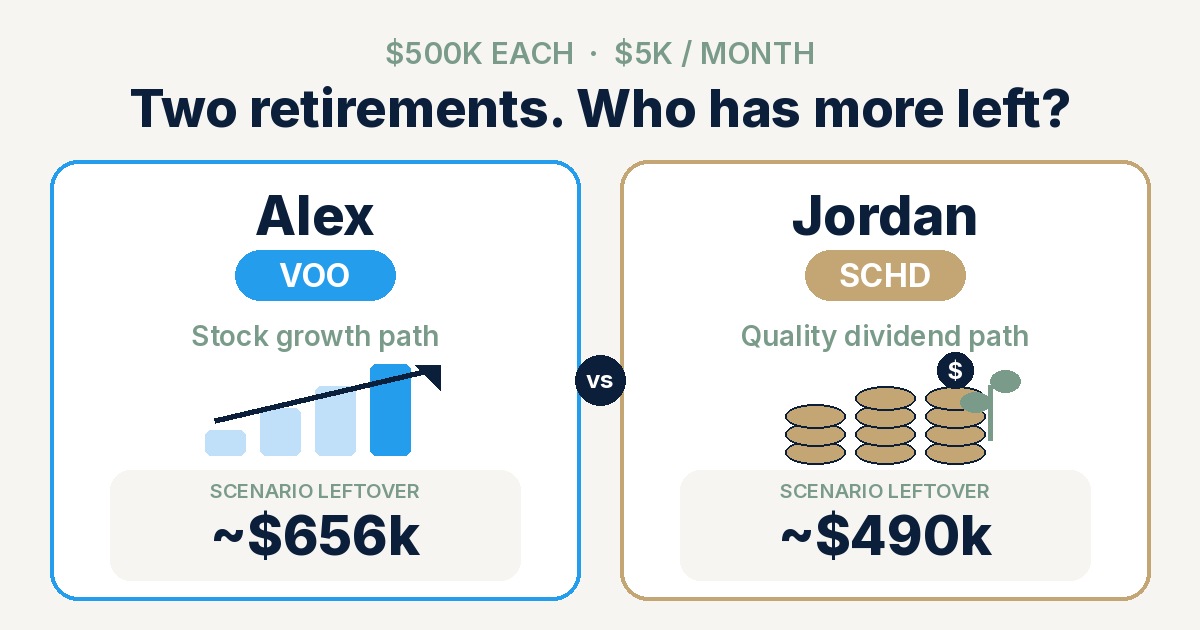
Alex put everything in VOO — plain S&P 500.
Jordan put everything in SCHD — a classic quality dividend ETF (Schwab U.S. Dividend Equity).
Today — October 28, 2026 — after 50 months and $250,000 cash taken from each account:
- Alex (VOO) has about $655,976 left.
- Jordan (SCHD) has about $489,970 left.
Alex is ahead by roughly $166,000.
Add back the same $250k both already spent: Alex’s path totals ~$906,000 (~+81%), Jordan’s ~$740,000 (~+48%).
That’s the honest headline. VOO finished with more money. SCHD paid more than twice the dividends — and still never covered a full month’s rent on dividends alone. Both sold shares almost every month. The gap is mostly price growth, not “who collected the check.”
This is an educational scenario, not advice. No taxes. No trading costs. Same lifestyle for both.
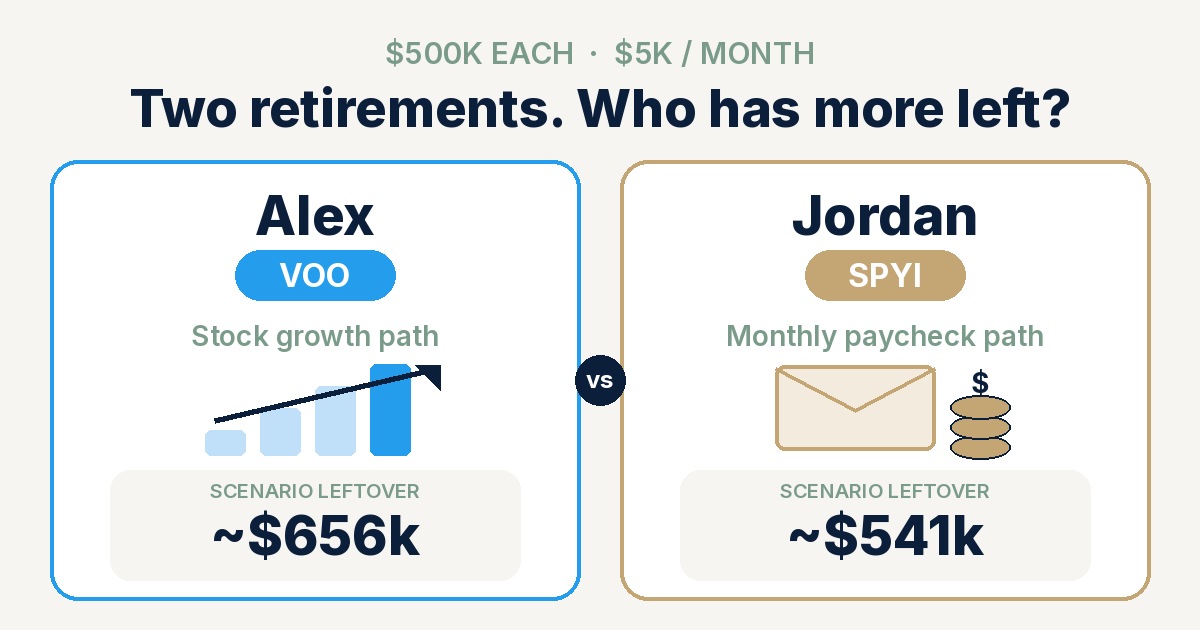
(If you already read the sibling living-off story with covered-call income — Two Retirements: SPYI vs VOO — same start date, same $5k habit. In that window SPYI finished around $541k. SCHD finished below that here. Different tools, same question: leftover wealth after funding the month.)
Day one: same pile, different bet
August 30, 2022 sat near the 2022 market low — a long runway for whoever kept more uncapped equity growth.
Both agreed on one simple habit:
- Take dividends first.
- Sell shares only if that month’s cash fell short of $5,000.
- If a dividend ran over $5,000, reinvest the excess the same day.
Then they lived.
Jordan wasn’t chasing a “high yield” gimmick. SCHD is the quality-dividend sleeve a lot of us already keep calm with alongside VOO — see 5 reasons SCHD earns a look and our Keep Calm portfolio framing. This piece asks a narrower question: if that was your whole pile and you needed $5k a month, how did it feel?
What it felt like month to month
Both of them sold — almost every month
Here’s the part that surprises people who hear “dividend ETF” and picture a paycheck:
Neither Alex nor Jordan had a single month where dividends alone covered the full $5,000.
0 of 50 for VOO. 0 of 50 for SCHD.
Both funds pay quarterly, not monthly. A $5k monthly need still forced share sales in the other months — and usually a top-up even in dividend months.
Jordan (SCHD): more dividend dollars, same selling habit
Across the stretch, SCHD paid about $70,899 in dividends — more than 2× Alex’s VOO dividends (~$32,373).
That helped. It did not erase the sell ticket.
By October 2026, Jordan’s share count was down about ~32% — roughly 20,545 → 13,963 shares (split-adjusted), at about $35.09, for ~$489,970. The share price had risen from around $24.34 — solid, but not a double.
So Jordan got a nicer dividend stream and still lived mostly on selling shares — just slightly less often / slightly smaller top-ups when the quarterly check arrived.
Alex (VOO): quieter dividends, louder price
Alex’s dividends stayed quiet (~$32k total, quarterly). Almost every month meant selling shares to hit $5,000.
Share count also fell about ~32% — roughly 1,366 → 925. But the share price roughly doubled, from around $366 to $709. Ending pile: ~$655,976.
Alex won the wealth scoreboard while carving pieces off a rising market. Same selling rhythm as Jordan — different leftover, because the remaining shares were worth far more.
Where they stand today (one small scoreboard)
| Alex — VOO | Jordan — SCHD | |
|---|---|---|
| Ending portfolio | ~$655,976 (~925 @ ~$709) | ~$489,970 (~13,963 @ ~$35.09) |
| Cash already withdrawn | $250,000 | $250,000 |
| Ending + cash | ~$906,000 (~+81%) | ~$740,000 (~+48%) |
| Dividends collected | ~$32,373 | ~$70,899 (~2×+) |
| Months dividends fully covered $5k | 0 / 50 | 0 / 50 |
| Share count | Down ~32% (~1,366→925) | Down ~32% (~20,545→13,963, split-adj) |
| Price path | ~$366 → ~$709 | ~$24.34 → ~$35.09 (split-adj) |
Same life. Same selling habit. Different leftover — mostly from growth, not from who got more dividend mail.
Why Alex pulled ahead in this stretch
Three plain reasons:
The calendar favored broad growth. Starting near the 2022 low rewarded uncapped S&P exposure. SCHD’s quality-dividend screen is a deliberate tilt — often more defensive, less mega-cap growth heavy. In a roaring recovery led by the broad market (and the usual growth names), that tilt can lag on total wealth even while it pays more cash along the way.
Both sold about a third of their shares. Dividend edge didn’t save Jordan’s share count. When the need is $5k a month and the fund pays quarterly, you’re still a seller. The winner was whoever’s remaining shares compounded harder.
More dividends ≠ a full living paycheck. SCHD’s ~$71k in dividends was meaningful — and still short of the $250k both withdrew. The gap between “nice yield” and “covers the month” is the whole lesson.
For ongoing sleeve context (VOO / QQQM / SCHD and friends), see the Keep Calm update. SCHD still belongs in a calm portfolio conversation — this story isn’t “dump SCHD”; it’s “don’t expect classic quarterly dividends alone to fund $5k/month off a $500k pile without selling.”
When Jordan’s SCHD design still matters
I like SCHD for a specific job: quality dividend exposure — companies with a history of paying (and often growing) dividends, as a sleeve beside broad growth — not as a promise that yield will replace a paycheck.
That job still matters when:
- You want more cash along the way than plain VOO (Jordan collected ~2× the dividends)
- You’re building a multi-sleeve portfolio, not forcing one ETF to be the whole retirement paycheck
- You’re thinking in decades, not crowning a winner from one bull stretch off a market low
- You already treat dividends as a component of return, not proof of safety
What this story does not prove:
- That SCHD is a bad fund
- That dividends don’t matter
- That VOO always beats SCHD forever
It proves something narrower: same $5k lifestyle, same selling rhythm, different leftover — and in this window, plain VOO’s price growth left more money on the table even though SCHD paid more than twice the dividends.
(Optional rabbit hole if you’re still building beyond a single ticker: building wealth beyond VOO and QQQ. And if SCHD’s dips are when you’d rather add than compare spend-downs: why SCHD’s dip can be a start signal.)
The takeaway
Alex and Jordan both made it through 50 months on $5,000 a month. Both sold shares almost every month. Neither fund’s dividends ever covered a full $5k month alone.
Alex has more money left.
Jordan collected more than twice the dividends — and still finished behind on total wealth.
VOO grew more. SCHD paid more along the way. Neither replaced selling.
Pick that tradeoff on purpose — not because a dividend yield looked comforting on a fund page.
And if you’re comparing income-design tools (covered-call monthly distributions) rather than classic dividend quality, the sibling piece — SPYI vs VOO living-off — is the other side of the same coin.
Quick FAQ
Did both withdraw the same cash?
Yes. 50 × $5,000 = $250,000 each.
Why didn’t SCHD’s higher dividends cover the month?
~$71k over 50 months is real money — but it’s still far short of $250k, and it arrives quarterly. A $5k monthly need forces sales most months.
Did either path avoid selling?
No. 0 of 50 months fully covered by dividends for both.
Is SCHD “worse” than VOO?
Not the point. Different design. In this spend-down window from a market-low start, VOO left more leftover wealth. SCHD still paid more cash along the way and remains a quality-dividend sleeve in a broader plan.
Would a different start date change the gap?
Likely. A stretch that favors dividend/value tilts could narrow or flip relative performance. Don’t crown a forever champion from one window.
Disclaimer
Educational scenario only — not financial, tax, or investment advice. Figures follow the same living-off method as our SPYI vs VOO sibling (dividends first, sell for shortfall, reinvest excess; Yahoo-style closes; no taxes/fees) from August 30, 2022 through October 28, 2026; roundings are approximate; SCHD share/price figures are split-adjusted. Past performance does not predict future results. Consider your own cash needs, tax situation, and risk tolerance — and a qualified professional if you need advice.