When you hear “SALT,” you might think of the stuff you sprinkle on fries — but in the world of taxes, SALT stands for State and Local Taxes. It represents the taxes you pay to your state and city governments — things like income taxes, property taxes, and sometimes sales taxes.
For decades, Americans could deduct those state and local taxes from their federal taxable income. But that all changed in 2017 with the Tax Cuts and Jobs Act (TCJA), which capped the SALT deduction at $10,000. High-income households in high-tax states like California, New York, and New Jersey felt the pinch immediately.
Now, under President Trump’s new “Big Beautiful Bill” (as he calls it), the SALT deduction is back in the spotlight — expanded, but with some fine print that deserves your attention. Let’s unpack what’s changing, and what’s not being talked about.
The New SALT Deduction Rules
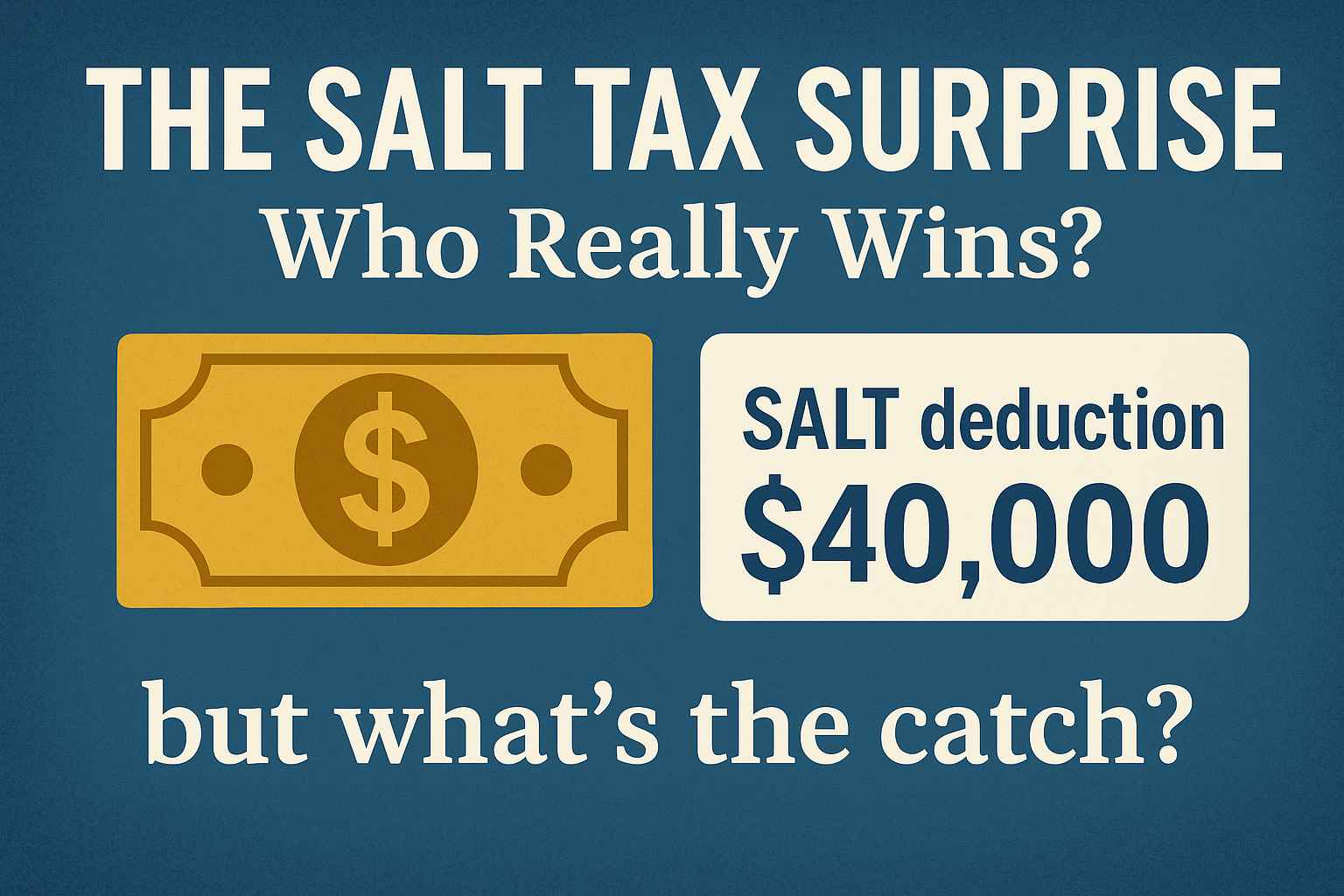
Starting in 2025, the SALT deduction cap will increase from $10,000 to $40,000 for many taxpayers. On paper, that sounds like a huge win — four times the deduction, right?
Well, yes… but not for everyone.
Here’s the breakdown:
- The cap rises to $40,000 for joint and single filers.
- The deduction phases down for taxpayers whose Modified Adjusted Gross Income (MAGI) exceeds $500,000.
- By the time your MAGI hits around $600,000, your SALT cap effectively shrinks back to $10,000 again.
- The cap will increase about 1% per year through 2029, but after that, it’s scheduled to revert back to the $10,000 limit in 2030 unless Congress acts to extend it.
In short: this new benefit is temporary — and it tapers off fast as your income rises.
The Hidden Limitations Nobody’s Talking About
While the headlines celebrate a “SALT tax cut for everyone,” the fine print tells a more complicated story. Here are the under-discussed limitations you should know.
1. The “SALT Torpedo” Effect
If your income is near the $500,000–$600,000 range, your deduction phases out gradually — meaning your effective tax rate spikes as you earn more. That’s called the “SALT torpedo.” You can actually end up paying higher marginal taxes for earning a little more money. Ouch.
2. You Still Have to Itemize
If you take the standard deduction, you won’t benefit from the higher SALT limit at all. And since the TCJA doubled the standard deduction, millions of taxpayers no longer itemize. For those folks, this entire SALT change means nothing.
3. It’s Temporary
The increased cap isn’t permanent. Starting in 2030, it’s scheduled to drop back to $10,000 — unless future legislation extends it. So any planning should assume this is a short-term window.
4. Inflation Can Erode the Benefit
The income thresholds are indexed slightly for inflation, but not aggressively. If your income rises naturally with inflation or promotions, you might lose eligibility for the full deduction faster than you expect.
5. Unequal State Impact
The biggest winners are still in high-tax states — California, New York, New Jersey, Illinois, Massachusetts. If you live in Florida, Texas, or Nevada (no state income tax), your SALT deduction doesn’t matter much to begin with.
6. Pass-Through Workarounds Stay in Play
Business owners using Pass-Through Entity Taxes (PTETs) can still bypass the SALT cap in creative (but legal) ways, since those taxes are paid at the entity level. Regular wage earners don’t have that luxury. So yes, inequality in the system remains.
7. AMT Still Lurks
Although fewer taxpayers are hit by the Alternative Minimum Tax (AMT) these days, it can still limit your ability to benefit from deductions — SALT included. So don’t assume you’re completely in the clear.
The Planning Takeaway
Here’s the bottom line:
- If your income is below $500,000 and you itemize, the new $40,000 cap could save you thousands in federal taxes.
- If you’re between $500K–$600K, be careful — the “SALT torpedo” could mean smaller benefits and surprise tax jumps.
- If you’re above $600K, you’re probably right back where you started: capped at $10,000.
- And for most middle-income earners who take the standard deduction, nothing changes at all.
So before you celebrate, run the numbers or talk to your CPA. A little planning can go a long way.
The Bigger Picture
The new SALT deduction expansion sounds generous, but its structure is political as much as financial. It gives temporary relief to upper-middle-income households, while phasing out quickly for higher earners — and doing little for the middle class.
In other words, the “Big Beautiful Bill” isn’t a tax revolution. It’s a saltier version of the same soup: temporary, tiered, and tailor-made for a narrow slice of taxpayers.
Final Thought
Tax law changes often make big headlines but small impacts — unless you know how to navigate them. Whether you’re in a high-tax state or not, staying aware of how the SALT rules work can help you make smarter decisions about when and how to pay your state and property taxes.
Because sometimes, the difference between saving thousands and losing them… is just a pinch of SALT.
Related Articles:
- The Hidden Tax Cost of Dividend Income in Retirement
- The Beginner’s Guide to Tax Brackets(Without the Boring Stuff)
Financial and Legal Disclaimer
The content provided on HelpYourFinances.com is intended for general informational purposes only and does not constitute financial, legal, or professional advice. While we make every effort to ensure the accuracy and reliability of the information presented, it is important to understand that financial and legal matters are complex and highly individual.
HelpYourFinances.com is not a licensed financial planner, investment advisor, legal professional, or law firm. The materials on this website should not be considered a substitute for personalized advice from qualified financial advisors, attorneys, or other licensed professionals who can assess your unique situation.
Before making any financial, legal, or other important decisions, we strongly encourage you to seek advice from qualified experts. Any reliance you place on the information provided here is strictly at your own risk. HelpYourFinances.com, its owners, and contributors disclaim any liability for actions taken based on the content of this website.