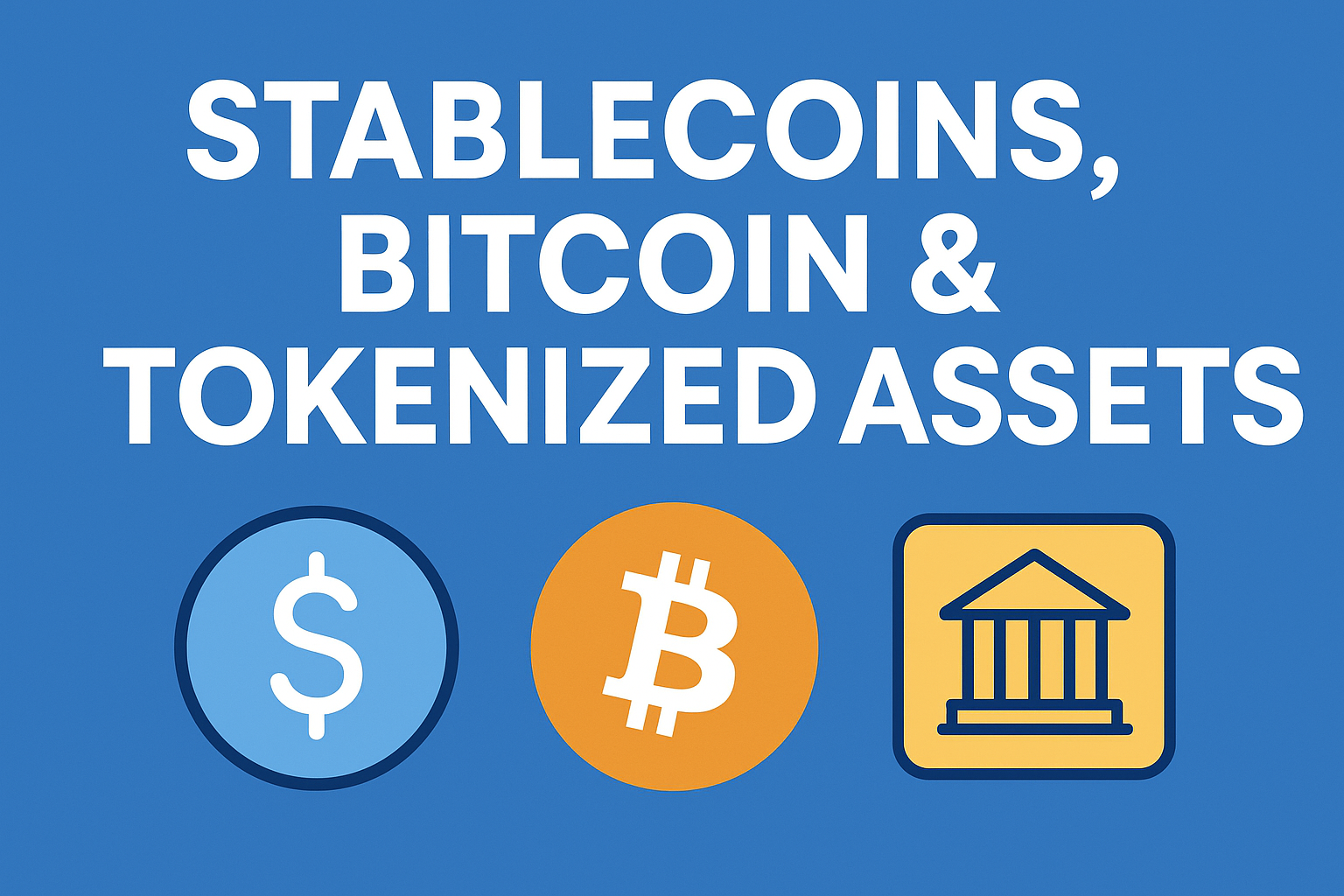
Stablecoins, Bitcoin, and Tokenized Assets
Imagine walking into a grocery store with three different wallets:
- One filled with gold bars (hard to carry, but valuable).
- Another filled with dollar bills (easy to spend, stable in value).
- And a third wallet containing shares of buildings, paintings, and stocks that you can trade instantly.
That’s what the world of digital assets looks like today. The terms Bitcoin, stablecoin, and tokenized assets might sound intimidating, but at their core, they represent these three simple concepts:
- Bitcoin = Digital gold.
- Stablecoin = Digital dollar.
- Tokenized assets = Digital versions of real-world investments.
If you’ve never owned any crypto or digital tokens before, don’t worry. By the end of this article, you’ll understand the differences, how they work, and why they matter for the future of money.
What is Bitcoin?
Bitcoin is the world’s first cryptocurrency, launched in 2009. Think of it as gold in digital form. Like gold, it’s scarce — only 21 million bitcoins will ever exist. Instead of being mined from the ground, Bitcoin is “mined” by computers solving complex problems on a network.
Key Features of Bitcoin:
- Scarcity – Just like gold, there’s a limited supply. This scarcity is part of what makes it valuable.
- Decentralization – No bank or government controls Bitcoin. Transactions are verified by a global network of computers.
- Volatility – Unlike dollars or euros, Bitcoin’s price swings a lot. It can jump or drop by thousands of dollars in a single day.
- Digital Ownership – Owning Bitcoin means you hold a digital key (like a password) that gives you full control, without needing a bank.
How People Use Bitcoin:
- Investment: Many see it as “digital gold” and hold it long-term, hoping its price will rise.
- Hedge against inflation: In countries where local currency loses value, some people turn to Bitcoin to protect their wealth.
- Payments: While possible, it’s not widely used day-to-day because of its price volatility.
👉 Think of Bitcoin as a speculative investment asset, not a stable currency.
What are Stablecoins?
Now, imagine if you had a digital coin that worked exactly like a dollar bill — stable in value, easy to send, and usable worldwide. That’s a stablecoin.
Stablecoins are cryptocurrencies designed to maintain a 1:1 value with traditional money like the U.S. dollar. The most popular one, USDC (USD Coin), is backed by real cash and short-term U.S. Treasuries stored by regulated financial institutions.
Key Features of Stablecoins:
- Stability – Always worth about $1. If you send someone 100 USDC, it’s the same as sending $100.
- Blockchain-Powered – Like Bitcoin, transactions happen on blockchain networks, which are fast and transparent.
- Backed by Reserves – Each stablecoin is backed by dollars or equivalent assets held in reserve, making it redeemable.
- Low Fees & Fast Transfers – Sending money across borders with stablecoins can be faster and cheaper than traditional bank transfers.
How People Use Stablecoins:
- Payments: Businesses and individuals can pay each other instantly without banks.
- Trading Crypto: Investors use stablecoins as a safe “parking spot” when they want to exit volatile coins like Bitcoin.
- Remittances: Families across borders can send money without costly wire fees.
👉 Think of stablecoins as digital dollars you can send anytime, anywhere.
What are Tokenized Assets?
Now, let’s move to something even more exciting — tokenization of assets.
Imagine owning a piece of a $10 million office building in New York without needing millions of dollars. Or investing in a Picasso painting by buying $100 worth of digital shares. That’s what tokenization makes possible.
Tokenization means turning a real-world asset (like real estate, stocks, or gold) into a digital token that represents ownership. These tokens live on a blockchain, making them easy to trade and transfer.
Key Features of Tokenized Assets:
- Fractional Ownership – You don’t need the full price of the asset. Instead of $1M for a building, you can own $100 worth.
- Liquidity – Assets that are usually hard to sell (like property) can be traded more easily through tokens.
- Transparency – Ownership records are stored on the blockchain, reducing fraud.
- Accessibility – Tokenization opens up investments to everyday people, not just institutions or the wealthy.
Examples of Tokenized Assets:
- Real Estate: Platforms are tokenizing commercial and residential properties.
- Art & Collectibles: High-value art can be split into tokens, letting anyone own a fraction.
- Stocks & Funds: BlackRock launched a tokenized fund in 2024, showing even Wall Street is exploring this.
👉 Think of tokenized assets as digital “shares” of real-world investments.
Comparing Bitcoin, Stablecoins, and Tokenized Assets
| Feature | Bitcoin (BTC) | Stablecoins (USDC, etc.) | Tokenized Assets |
|---|---|---|---|
| What it is | Digital gold | Digital dollar | Digital version of real-world assets |
| Stability | Very volatile | Stable (pegged to USD) | Depends on asset (real estate, stocks, gold) |
| Supply | Fixed at 21M | Expands/shrinks with demand | Expands based on assets being tokenized |
| Use Case | Investment, hedge | Payments, transfers, trading | Investment access, fractional ownership |
| Backing | None (market-driven) | USD reserves & Treasuries | Real-world assets |
| Risk | Price swings | Reserve management & regulation | Legal and adoption challenges |
Why Does This Matter?
For someone new to digital assets, it may seem like a niche experiment. But here’s why it’s important to pay attention:
- Money is Changing – Just like checks turned into credit cards, and credit cards turned into mobile wallets, blockchain-based money is the next step.
- Opens Up Investments – Tokenization makes it possible for everyday people to invest in things once reserved for the ultra-wealthy.
- Faster & Cheaper Transactions – Stablecoins already prove that money can move across the globe in seconds at low cost, far faster than traditional banks.
- Global Accessibility – Billions of people around the world don’t have access to banks but do have smartphones. Digital assets bring them into the financial system.
- Innovation Momentum – With major players like BlackRock, JPMorgan, and even governments building on blockchain, the chances of this becoming mainstream are high.
Conclusion: The Future of Finance is Digital
Bitcoin, stablecoins, and tokenized assets may sound like buzzwords, but they represent a fundamental shift: money, investments, and ownership are moving to the digital world.
- Bitcoin teaches us that people are willing to store and trade value outside traditional systems.
- Stablecoins show that dollars can move at the speed of the internet.
- Tokenized assets prove that ownership of real-world wealth can be democratized and shared like never before.
Will every blockchain project succeed? No. Just like the dot-com bubble, many will fail. But the technology itself is here to stay. Knowing the differences between these digital tools isn’t just about curiosity — it’s about preparing for a future where finance is more open, global, and digital.
👉 Whether you’re an investor, business owner, or simply someone curious about money, understanding these concepts today could give you a front-row seat to the financial world of tomorrow.
Related Articles:
Financial and Legal Disclaimer
The content provided on HelpYourFinances.com is intended for general informational purposes only and does not constitute financial, legal, or professional advice. While we make every effort to ensure the accuracy and reliability of the information presented, it is important to understand that financial and legal matters are complex and highly individual.
HelpYourFinances.com is not a licensed financial planner, investment advisor, legal professional, or law firm. The materials on this website should not be considered a substitute for personalized advice from qualified financial advisors, attorneys, or other licensed professionals who can assess your unique situation.
Before making any financial, legal, or other important decisions, we strongly encourage you to seek advice from qualified experts. Any reliance you place on the information provided here is strictly at your own risk. HelpYourFinances.com, its owners, and contributors disclaim any liability for actions taken based on the content of this website.