
Updated November 2026 · Part 1 of 2 in our HSA series
Leaving a job comes with a pile of loose ends: the last paycheck, COBRA paperwork, the 401(k). The health savings account (HSA) is the one people forget about most. It just sits there at whatever provider the old employer picked.
That’s a missed opportunity, because an HSA can be one of the most useful accounts you have. So let’s walk through it with an example.
Meet Joe (an example, not a real person). Joe had a high-deductible health plan (HDHP) at his last job and used the HSA that came with it. He’s left that job, the account holds about $5,000, and he’d like that money to keep growing for retirement, roughly 15 years from now.
This post (Part 1) covers the logistics: what Joe owns, where the money should live, how to move it, and the rules he needs to know. How he invests it comes in Part 2.
Step 1: Know that the money is still Joe’s
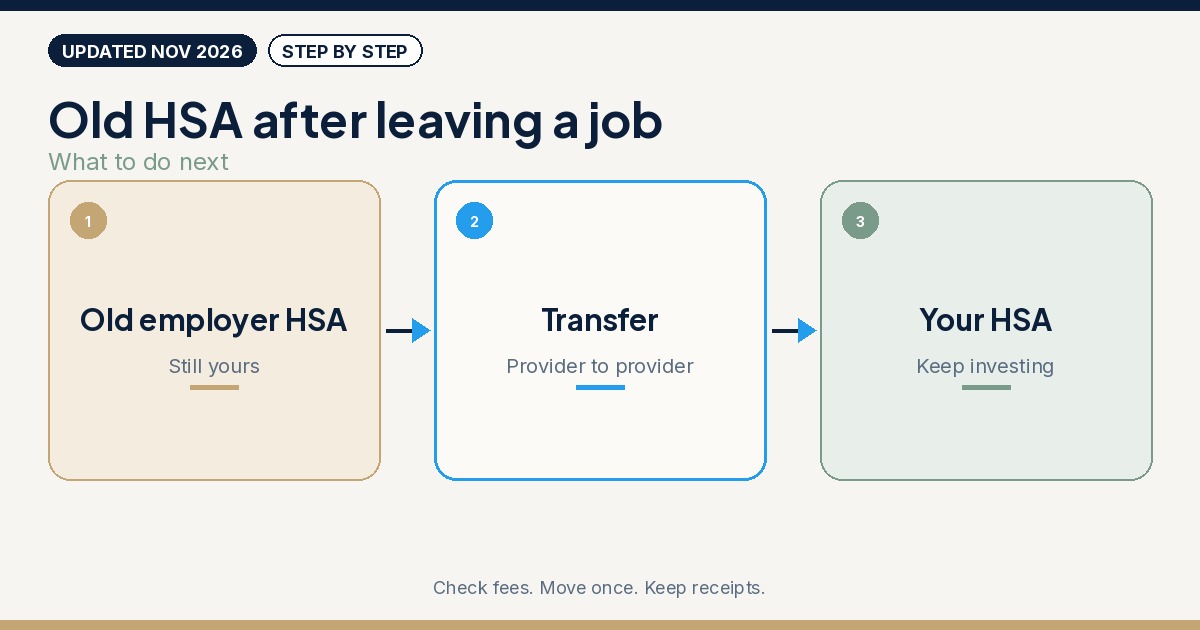
This is the most common worry, so let’s start here. An HSA belongs to you, not your employer. The IRS says it plainly: an HSA is “portable,” and it “stays with you if you change employers or leave the work force” (IRS Pub. 969).
There’s no use-it-or-lose-it deadline like a health FSA has, and Joe doesn’t have to cash it out. Unused money carries over year after year.
Leaving the job does change two things:
- Joe may lose the right to put new money in. That depends on his new health coverage (Step 6).
- The old employer may stop paying the account’s fees. Many employers cover the HSA’s monthly admin fee while you work there. Once you leave, that fee often moves onto your account.
Neither one puts the $5,000 at risk. Joe just has some decisions to make.
Step 2: Check what the old HSA is costing him
Before Joe moves anything, he should log in to the old provider (or call them) and pull up the current fee schedule. Here’s what to look for:
- Monthly or annual admin fees, especially any that start once you’re no longer with the employer.
- Investment fees: a fee for using the investment side, or a separate platform fee on top.
- Cash minimums: some providers make you keep, say, the first $1,000 or $2,000 in cash before you can invest the rest.
- Investment menu: a short list of funds, or a broad choice of low-cost index funds and ETFs?
- Interest on cash: some HSA cash accounts pay almost nothing.
- Outbound transfer or closing fees: a one-time charge to move the money out.
- Paper statement or low-balance fees.
A few dollars a month doesn’t sound like much. But on a $5,000 balance, a $3–$4 monthly fee comes to roughly 1% a year, before Joe has invested a dollar. Over 15 years, that drag adds up.
If the old HSA is cheap and has good funds, Joe can leave it where it is. Moving isn’t required. The point is to make the decision on purpose.
Step 3: Pick a low-fee HSA provider (if moving makes sense)
If the old account is expensive or limited, Joe can open an HSA with a provider he chooses himself. No IRS permission is needed (Pub. 969), and he doesn’t need to be HSA-eligible just to open one and move money into it from another HSA.
One example: the Fidelity HSA. As of November 2026, Fidelity says its individual (retail) HSA opened through Fidelity.com has zero account fees and zero account minimums, and you can transfer an existing HSA in “at any time, even if not enrolled in an HDHP” (Fidelity HSA). Uninvested cash goes into a government money market fund by default.
Three fine-print points worth knowing:
- “No account fees” doesn’t mean free investing. The funds and ETFs you buy still have their own expense ratios, and some funds have minimums.
- Workplace versions can differ. Fidelity notes that when its HSA is offered through an employer, the employer pays a recordkeeping fee of up to $48 a year and may pass it on to employees. The retail account and an employer plan aren’t always priced the same.
- Fidelity isn’t the only option, and no provider is best for everyone. Compare fees, the fund lineup, how easy reimbursements are, and the cash rate. Then choose.
Step 4: Move it the right way (transfer vs. rollover)
There are two ways to get money from the old HSA into the new one, and the difference matters.
Trustee-to-trustee transfer (usually the better choice). Joe asks the new provider to pull the money directly from the old one. The money never touches his bank account. The IRS says a direct transfer “isn’t considered a rollover,” and there’s no limit on the number of these transfers. It’s not income, not a deduction, and not reported as a distribution (Pub. 969).
60-day rollover. The old provider sends Joe a check, and he deposits it into the new HSA. He has to finish within 60 days of receiving it, and he’s allowed only one rollover in any 1-year period (that’s a rolling 12 months, not a calendar year). Miss the window and the money is generally treated as a taxable distribution, possibly with the 20% additional tax if he’s under 65.
| Trustee-to-trustee transfer | 60-day rollover | |
|---|---|---|
| Who moves the money | Provider to provider | You receive it, then redeposit it |
| Federal tax if done right | None | None |
| How often allowed | Unlimited | Once per 1-year period |
| Deadline risk | Low | Must finish within 60 days |
| Need to be HSA-eligible? | No | No |
Practical tips for the move:
- Expect it to take a while. Timing varies by provider. Fidelity estimates a transfer usually takes 2–5 weeks and sometimes longer (Fidelity: Transfer your HSA).
- Total timeline isn’t the same as time out of the market. Many providers move cash only, so funds in the old HSA may have to be sold first. How long Joe sits in cash depends on when those investments are sold and whether they can move in kind. He won’t automatically be out of the market for the whole 2–5 weeks. Fidelity notes an old HSA may sit in two parts, a cash account and a brokerage account, so check both.
- Keep some medical money reachable. During the move, Joe can’t spend from the money in transit. If he expects a medical bill soon, he should hold enough elsewhere to cover it, or wait until the transfer settles.
- Ask about the exit fee and whether they’ll close the account automatically. Partial transfers can leave a small balance that keeps getting charged fees.
Step 5: Name a beneficiary
When Joe opens the new account (or updates the old one), he should name a beneficiary. This one is quick, and it matters.
Per the IRS (Pub. 969):
- If a spouse is the beneficiary, the HSA becomes the spouse’s own HSA.
- If someone else is the beneficiary, the account stops being an HSA, and its fair market value is generally taxable to that person in the year of death. That amount can be reduced by the deceased’s qualified medical expenses the beneficiary pays within a year.
- If the estate is the beneficiary, the value goes on the final tax return.
Beneficiary designations don’t carry over automatically to a new provider, so Joe should set one up on the new account.
Step 6: Understand when he can (and can’t) contribute again
Here’s where people get tripped up. Joe doesn’t need to be eligible to contribute in order to keep, transfer, invest, or spend his HSA. Eligibility only affects new contributions.
To contribute for a given month, the IRS says he has to be (Pub. 969):
- Covered by an HSA-qualified HDHP on the first day of the month,
- Without other disqualifying health coverage (for example, a general-purpose health FSA, or a spouse’s non-HDHP plan that covers him),
- Not enrolled in Medicare, and
- Not someone who can be claimed as a dependent on another person’s return.
So having a high-deductible plan isn’t enough by itself. The plan has to qualify, and Joe can’t have other coverage that disqualifies him.
If Joe’s new job offers a qualifying HDHP, he can start contributing again. For 2026 the limits are $4,400 for self-only coverage and $8,750 for family coverage, and employer contributions count toward the limit (Pub. 969). If he’s eligible for only part of the year, his limit is usually prorated by month. There’s a special exception called the “last-month rule,” but it has a testing period that can cost you if you lose eligibility, so check the Form 8889 instructions or ask a tax pro before relying on it.
Age-55 catch-up. Once Joe is 55 or older by the end of the year and eligible, he can add $1,000 a year on top of the limit. It’s prorated the same way, and it ends when he enrolls in Medicare. Starting with his first month of Medicare, his contribution limit drops to zero, and that includes any retroactive Medicare coverage (Pub. 969). Retiring doesn’t end HSA eligibility on its own. Medicare enrollment is what matters.
Step 7: Keep receipts, possibly for 15+ years
A big HSA perk: there’s no federal deadline to reimburse yourself (IRS Notice 2004-50, Q&A 39). If Joe pays a qualified medical bill out of pocket today and lets the HSA keep growing, he can generally reimburse himself years later, tax-free, as long as he can prove it.
The rules (Pub. 969; Notice 2004-50):
- The expense has to be incurred after the HSA was established. (Good news for Joe: an HSA funded by a transfer or rollover from another HSA counts as established on the date the original account was.)
- It can’t have been reimbursed elsewhere (insurance, an FSA) or taken as an itemized medical deduction.
- He has to keep records showing all of the above.
What to save: itemized receipts, proof of payment, insurance EOBs (explanation of benefits), and a simple ledger (date, provider, amount, reimbursed yes/no). If the expense might be reimbursed in 15 years, the records need to last 15 years too. Use cloud storage with a backup, not a shoebox of fading thermal paper.
Step 8: Know the age-65 rules (and that an HSA isn’t tax-free for everything)
- Qualified medical expenses: federally tax-free at any age.
- Non-medical withdrawals before 65: taxed as income plus a 20% additional tax. The 20% doesn’t apply after disability or death, but that only waives the extra tax; non-medical amounts are still taxable income.
- Non-medical withdrawals at 65 or older: taxed as ordinary income, with no 20% additional tax, similar to a traditional IRA (Pub. 969).
So an HSA isn’t “tax-free for anything.” It’s tax-free for medical expenses, and works like a traditional IRA for everything else after 65.
Step 9: Check your state
All of the above is federal treatment, and not every state follows it. California and New Jersey still don’t follow it under current state law: contributions can be taxable at the state level, and interest, dividends, and capital gains inside the HSA generally count as state income in the year they’re earned. Bills to change this have been proposed but haven’t become law. If Joe lives in either state, or moves to one, he should keep yearly earnings records and check the current rules (California FTB Pub. 1005; California Schedule CA instructions; New Jersey NJ-WT guide).
Joe’s checklist
- [ ] Log in to the old HSA. Write down the balance, cash vs. invested split, and the full fee schedule.
- [ ] Decide: stay (low fees, good funds) or move.
- [ ] If moving: open the new HSA and start a trustee-to-trustee transfer from the new provider’s side.
- [ ] Keep enough cash available for any near-term medical bills while the transfer settles.
- [ ] Confirm the old account is fully emptied and closed.
- [ ] Name a beneficiary on the new account.
- [ ] Check whether his new health coverage makes him HSA-eligible before contributing again.
- [ ] Set up a receipts folder and reimbursement ledger.
- [ ] Check his state’s HSA tax treatment.
FAQ
Do I lose my HSA if I quit or get laid off? No. It’s yours, and the money stays in the account.
Can I transfer my HSA if I’m not on an HDHP anymore? Yes. You don’t need to be eligible to move money from one HSA to another.
Is a rollover the same as a transfer? No. A direct transfer is unlimited. A 60-day rollover is allowed once per 1-year period and has a deadline.
Coming in Part 2 tomorrow
In Part 2 tomorrow, we’ll get to the fun part: how Joe can invest that $5,000 so it has the best shot at growing over 15 years. We’ll cover how much to keep in cash, what to buy, and how to keep costs low.
This article is for educational purposes only and isn’t personal tax, legal, or investment advice. HSA rules, provider fees, and state tax treatment change. Check current details with your provider and a qualified tax professional before acting.