For three rounds we followed Alex, a Californian earning about $100,000 who started saving $500 a month in January 2021 for a $30,000 car. Here’s what we learned, in plain English.
The bracket in three lines
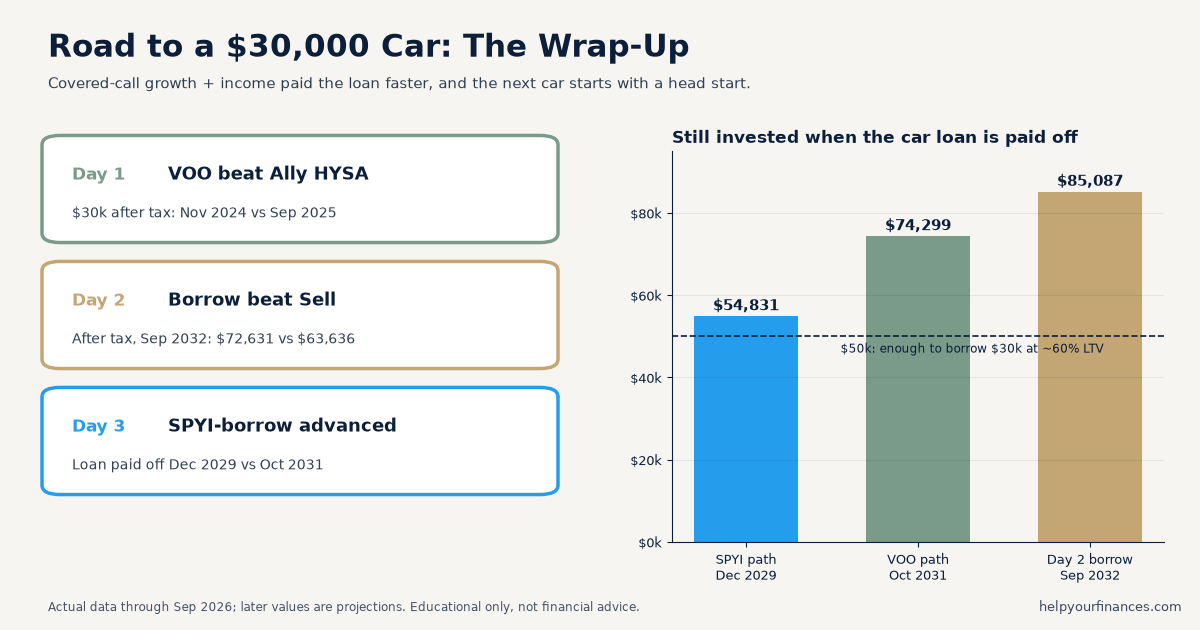
- Day 1: VOO beat the Ally high-yield savings account. VOO hit $30,000 after tax in November 2024 (47 months). Savings took until September 2025 (57 months). Read Day 1
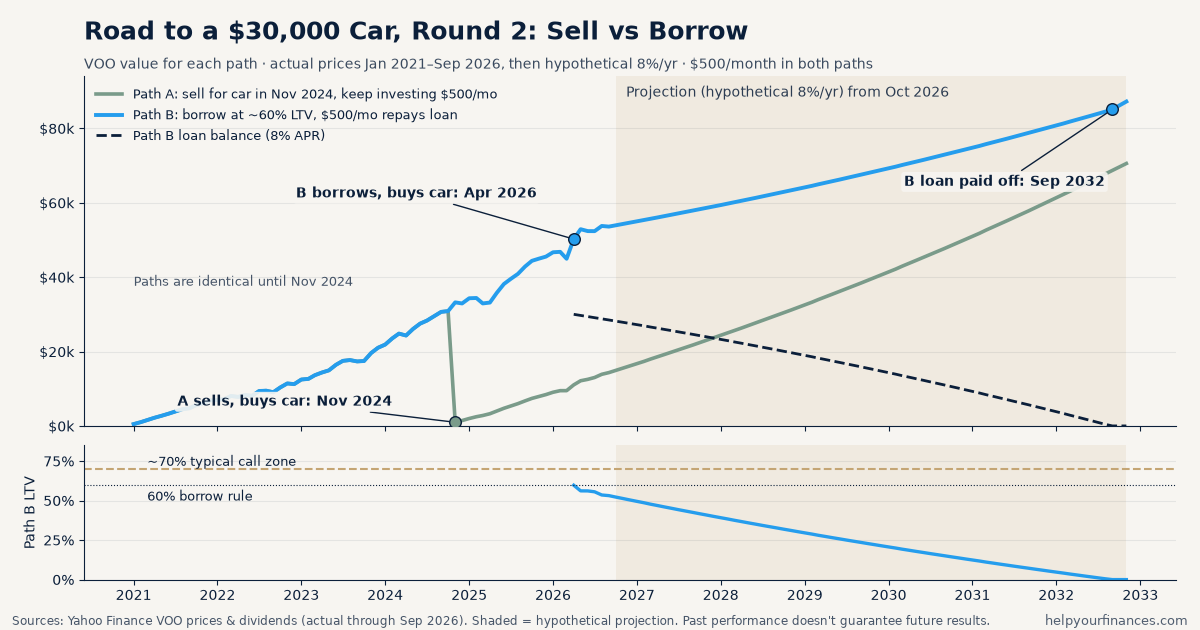
- Day 2: Borrow beat Sell (split decision). Selling got the car 17 months sooner, but borrowing against VOO left Alex with $72,631 after tax at the September 2032 payoff vs $63,636 for selling. Read Day 2
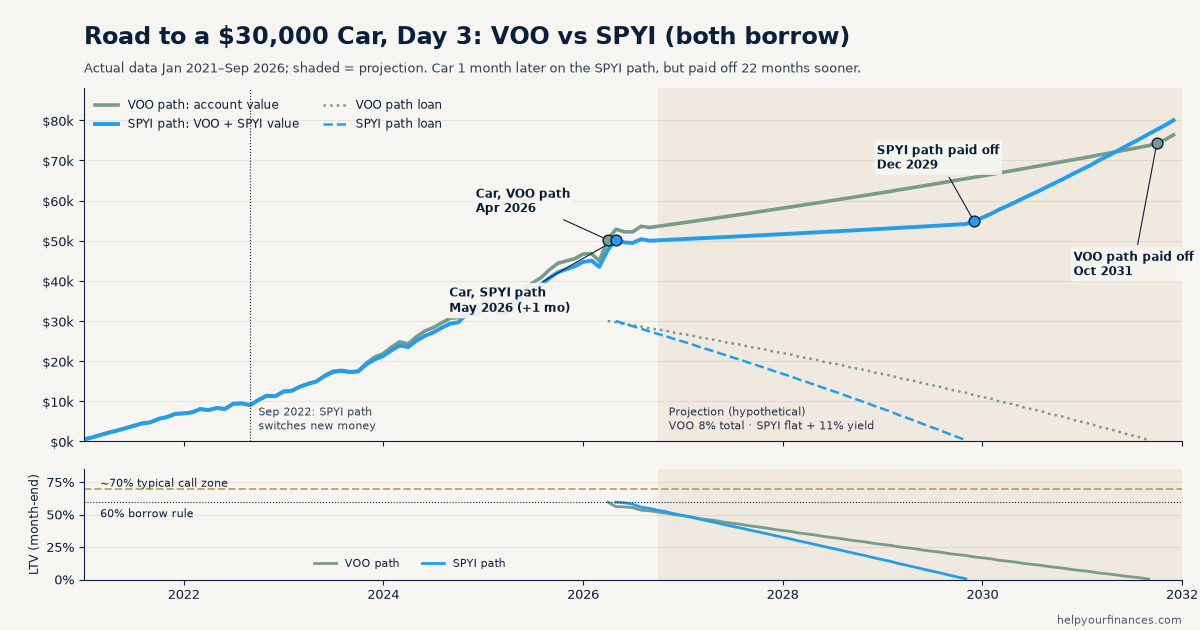
- Day 3: SPYI-borrow advanced (split decision). VOO got the car one month sooner (April vs May 2026), but the SPYI path paid off the loan in December 2029, 22 months earlier, with $4,524 of interest vs $7,209. Read Day 3
Covered-call ETFs: growth and income
The Day 3 winner kept Alex’s VOO shares and sent new money into SPYI, a covered-call ETF, starting in September 2022. That gave Alex both:
- Growth from the VOO shares that stayed invested.
- Income from SPYI’s monthly distributions.
That income is what makes covered-call funds handy for big purchases. Once Alex borrowed for the car, the distributions went straight to the loan. In the SPYI path, $13,210 of distributions helped pay off the loan, compared with $4,412 in the VOO path. The loan was gone in 43 months instead of 66.
By October 2031, when the VOO path finally paid off its loan, the SPYI path was worth $77,695 ($73,475 after tax) vs $74,299 ($64,429 after tax) for VOO.
The next car comes sooner
This is the part people miss. When you borrow, you never start over at zero.
On the sell route, Alex cashes out to buy the car, and the savings mostly start again. On the borrow route, the shares stay invested and keep growing while the loan gets paid down. So the day the loan is paid off, Alex already has a big head start on the next car:
- SPYI path, December 2029 payoff: $54,831 still invested ($22,576 VOO + $32,254 SPYI), or $51,303 after tax.
- VOO path, October 2031 payoff: $74,299.
- Day 2 borrow path, September 2032 payoff: $85,087.
Remember, Alex needed a $50,000 account to borrow $30,000 at about 60% loan-to-value. At its December 2029 payoff, the SPYI path is already past that line. In this model, Alex could borrow for car #2 right away instead of starting from scratch. And the account keeps growing the whole time.
The honest fine print
Real data favored VOO through September 2026. SPYI’s win depends on our projection after that (a flat share price and an 11% yield), and covered-call funds can lose share value over time. Borrowing against investments also carries margin-call risk if markets drop.
The takeaway
- Invest instead of parking long-term money in savings, if your timeline is flexible.
- Borrow against your assets instead of selling them, carefully, at about 60% LTV or less.
- Use income from a covered-call ETF to pay the loan down faster.
- Keep the assets. Your next car starts with a head start, not from zero.
Educational only, not financial advice.