
Updated November 2026
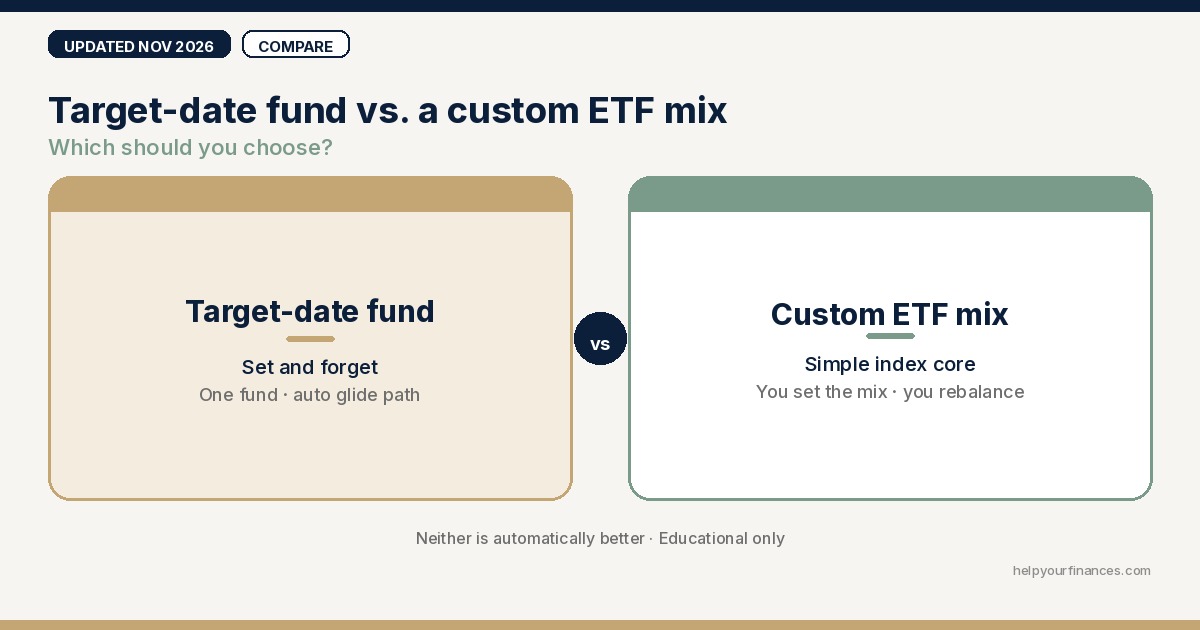
A target-date fund is the “one fund and you’re done” option in a lot of 401(k)s and IRAs. A custom ETF portfolio is the do-it-yourself version: you pick a few low-cost index funds, set the mix yourself, and rebalance when it drifts.
Neither one is automatically better. The useful question is whether you want set-and-forget or control — and whether you’ll actually do the work a custom mix requires.
This is a follow-up to our index funds vs. target-date funds in a 401(k) piece. That article compared a target-date fund with buying index funds in general. This one answers a tighter comparison: one target-date fund versus a portfolio you build yourself from a simple index core.
Educational only — not tax, legal, or investment advice.
The short version
A target-date fund is enough if you want a complete, automatically rebalanced mix that gets more conservative as you near retirement, and you’re fine with the fund’s fees and glide path.
A custom ETF (or index-fund) portfolio can make sense if you want a lower-cost mix, a stock/bond split the fund wouldn’t choose, or more control — and you’re willing to rebalance and keep the mix from getting messy.
In a 401(k), your menu may offer index mutual funds rather than ETFs. The idea is the same: one packaged target-date fund vs. a mix you assemble. In an IRA or brokerage account, low-cost ETFs are usually easier to buy.
Don’t stack a target-date fund with a bunch of other stock funds “just in case.” That’s how you accidentally undo the glide path.
What a target-date fund actually does
A target-date fund is named for a year — 2040, 2055, 2060 — close to when you expect to retire. Early on it holds mostly stocks. Over time it shifts toward bonds and other more conservative investments. That automatic shift is the glide path.
Two design details matter more than the year on the label:
- “To” vs. “through.” A “to” fund reaches its most conservative mix at the target date. A “through” fund keeps reducing stock exposure through that date, so it does not reach its most conservative point until years later. The Department of Labor’s guidance for plan fiduciaries flags this as something to check. The fund’s fact sheet will say which approach it uses, and how much it still holds in stocks at the target date.
- Index-based vs. actively managed. Many target-date funds are built from index funds and can be quite cheap. Others use actively managed funds and often cost more. Always read the expense ratio in your plan’s fee disclosure or the prospectus — not a generic “target-date funds are expensive” rule of thumb.
Example (dated, not a recommendation): Vanguard’s Target Retirement mutual funds (for example, Target Retirement 2070, VSVNX) listed an expense ratio of 0.08% as of January 28, 2026, per Vanguard’s Target Retirement 2070 fact sheet (September 30, 2026 edition). That figure includes the costs of the underlying funds. Many 401(k)s instead use Vanguard Target Retirement Trusts, which can have a different expense ratio — for example, Target Retirement 2055 Trust I listed 0.065% as of March 31, 2026. Other fund families, especially active target-date funds, can charge more. Check the number in your account.
In many 401(k)s, a target-date fund is also the default. Under DOL’s qualified default investment alternative (QDIA) rules, a target-date (or “life-cycle”) fund is one of the types of investments a plan can use as its default — the place contributions go if you never pick anything (DOL fact sheet on the final QDIA regulation). Auto-enrollment plus a QDIA is why so many people already own one. Being the default is a plan design choice, not a sign the fund is right for you, and it is not a blanket safe harbor from all fiduciary duties. The rules require that you be able to move out of the default at least as often as other plan options (and at least quarterly) without a financial penalty.
What a “custom ETF portfolio” means here
I’m not talking about a dozen niche ETFs or a stock-picking hobby. I mean a simple index core you assemble yourself, for example:
- A U.S. total-stock or S&P 500 fund
- An international stock fund
- A U.S. (or total) bond fund
Three funds can cover a lot of ground. Some people use two (a global stock fund plus a bond fund). The point is a mix you set, not a product that glides on its own.
In a 401(k): you use whatever index funds the plan actually offers. You may not see familiar ETF tickers. That’s fine. A Fidelity 500 Index or a Vanguard total-stock mutual fund does a similar job to the ETF version of the same idea — though an S&P 500 fund is not the same as a total-market fund.
In an IRA: you can usually buy the ETFs directly. A common illustration of a three-fund core is Vanguard Morningstar Total Stock Market ETF (VTI; formerly Vanguard Total Stock Market ETF), Vanguard Total International Stock ETF (VXUS), and Vanguard Total Bond Market ETF (BND). Vanguard lists prospectus expense ratios of 0.03% for VTI (as of April 28, 2026), 0.05% for VXUS (as of February 27, 2026), and 0.03% for BND (as of April 28, 2026). Depending on the weights, a simple mix at those rates lands roughly in the 0.03–0.05% range — the same low-fee neighborhood as a 0.08% index target-date fund, not a dramatic discount. Those are examples of a simple mix, not a recommended portfolio.
You own the allocation. If you want 90% stocks at 55, or more international than the target-date fund holds, you can set that. You also own the maintenance: when stocks rally and your mix is no longer what you intended, you rebalance. The target-date fund would have done that — and slowly reduced stocks — without a calendar reminder from you.
Side by side
| Target-date fund | Custom ETF / index mix | |
|---|---|---|
| What it is | One fund that holds the whole mix and changes it over time | You hold the pieces and set the percentages |
| Rebalancing | Automatic | You rebalance (or you don’t) |
| Glide path | Built in (“to” or “through”) | You must change the mix yourself as you age, or it stays as aggressive as you left it |
| Fees | One expense ratio for the package; index versions can be low, active versions often higher | You pay each fund’s expense ratio; a simple index mix can be very cheap, but only if you keep it simple |
| Control | Limited — you pick a year (or a nearby year for more/less stock) | High — you set stocks, bonds, and international weight |
| 401(k) reality | Often the plan default / QDIA; usually one fund family on the menu | Only works if the plan offers the building-block funds you want |
| Main failure mode | Paying up for an active fund you didn’t mean to buy, or stacking other funds on top | Complexity, overlap, and skipping rebalancing or the glide |
When a target-date fund is enough
For a lot of people, this is the right default.
- You want to contribute, get any match, and not tinker.
- You’re fine with a professionally designed glide path, even if it isn’t perfectly “you.”
- The fund in your plan is a low-cost index target-date fund, not a high-fee active one.
- You don’t have a strong reason to overweight or underweight a slice the fund already owns.
That’s a completely respectable choice. “I picked the 2050 fund and left it alone” has quietly built a lot of retirement balances. The automatic glide path can also reduce the temptation to make a very human mistake: staying 100% in stocks too long because selling feels like giving up, or dumping stocks after a crash and never getting back in. It doesn’t stop you from selling the fund itself.
If that’s you, pick the year closest to when you expect to retire, read the expense ratio and the glide path, and don’t add a pile of extra funds on top. Our 401(k) index vs. target-date guide walks through that checklist in more detail.
When a custom mix can make sense
A DIY portfolio earns its keep only if it does something the target-date fund doesn’t — and you follow through.
Fees. If your plan’s only target-date option is an expensive active fund, and the same plan offers cheap index funds you can combine yourself, building the mix can cut costs. Over many years, a 0.5-point fee gap compounds into real money, and unlike returns, it’s known in advance. If your plan already offers an index target-date fund around the 0.08% neighborhood, the fee win from going custom may be small.
Control. You might want a different stock/bond split than the fund’s year implies, more (or less) international exposure, or a bond sleeve you actually understand. A target-date fund won’t let you change one slice without changing the whole product (except by picking a different year, which is a blunt tool).
The glide path doesn’t fit. Some funds keep a sizable stock stake at the target date and keep de-risking for years afterward (“through”). Others reach their most conservative mix at the target date (“to”). If you’ve read the fact sheet and it’s a bad fit — and you’re willing to set your own path — a custom mix is how you do that on purpose.
You already rebalance elsewhere. If you have an IRA or taxable account you already manage as a simple index portfolio, mirroring that approach in a 401(k) can keep your whole picture consistent. Just add the accounts up. Owning a 2050 target-date fund in the 401(k) and a 90/10 stock mix in an IRA means your true allocation is a blend you may not have intended.
None of these reasons require a complicated portfolio. Two or three broad funds beat eight overlapping ones.
The main pitfalls
Complexity. Every extra fund is another thing to explain, rebalance, and accidentally duplicate. A “custom ETF portfolio” that turns into seven sector funds and a covered-call ETF is no longer a low-cost index core.
Behavior. The hidden cost of a DIY mix is you. Skipping rebalancing, panic-selling the stock fund, or never reducing risk as retirement gets close can matter more than a 0.05% fee difference. A target-date fund’s boring automation is a feature.
Overlapping funds. Holding a target-date fund plus an S&P 500 ETF means you now have more U.S. large-cap stock than the glide path assumed. The same thing happens if your custom mix includes both a total-stock fund and an S&P 500 fund without adjusting the weights. Overlap isn’t always wrong, but it should be intentional.
The 401(k) menu is limited. You can’t build a textbook three-ETF portfolio if the plan doesn’t offer the pieces. Sometimes the honest choice is: use the low-cost target-date fund in the 401(k), and build a custom mix in an IRA, where the menu is open.
Forgetting that QDIA is a default, not a life sentence. If you were auto-enrolled, look at what you actually own. Staying may be right. Not looking is how people pay an active-fund fee for a decade without meaning to.
A labeled fee illustration (not a forecast)
Fees are one of the few parts of this comparison you can measure in advance. Here’s a simple illustration of why the expense ratio is worth checking — not a prediction of market returns.
Assume $100,000 invested for 15 years, no additional contributions, compounded annually at a 6% annualized return before fees. (That 6% is an arbitrary assumption for the math. It is not a forecast or a typical-return claim.)
| Annual fee | Value after 15 years | Difference vs. the 0.08% fund |
|---|---|---|
| 0.08% (example index target-date level) | $236,957 | — |
| 0.20% | $232,962 | $3,995 less |
| 0.60% | $220,094 | $16,863 less |
Author’s calculation: ending value = (100{,}000 \times (1 + 0.06 – \text{fee})^{15}), compounded annually, rounded to the nearest dollar. Markets will not return a smooth 6%, and a custom mix is not “free” — you still pay each fund’s expense ratio, plus the time and risk of doing the work yourself.
If two options have almost the same fee, the decision usually comes down to control vs. automation, not a race for the last hundredths of a percent.
A simple way to decide
- Look at what you already own. If you were defaulted into a target-date fund, write down the year, the expense ratio, and whether it’s index-based or active.
- Read the glide path. How much is in stocks today, and at the target year? “To” or “through”?
- Scan the rest of the menu (or your IRA). Are there low-cost U.S., international, and bond index funds you could combine?
- Be honest about maintenance. Will you rebalance at least once a year and lower risk as you get closer to needing the money? If the answer is no, the target-date fund is doing you a favor.
- If you go custom, keep it to a few broad funds. Write the target percentages down. Don’t add a target-date fund on top of that mix.
- If you stay with the target-date fund, let it be the portfolio. That was the whole point.
Short FAQ
Is a custom ETF portfolio always cheaper?
No. A low-cost index target-date fund can be in the same fee neighborhood as a simple three-fund mix. Custom wins on cost mainly when the packaged fund is expensive, or when you’d pay a layer of advisory fees you don’t need. Always compare the actual expense ratios in front of you.
Can I use a target-date fund in my 401(k) and ETFs in my IRA?
Yes, but add the accounts together. If both are stock-heavy, you’re more aggressive than either account looks on its own. Treat it as one portfolio.
Should I pick a target-date year later than my retirement to stay in stocks longer?
Some people do that on purpose. It’s a rough way to change risk without building a custom mix. Know that you’re overriding the fund’s design, and check the new year’s allocation so the change is intentional.
Do I need ETFs specifically, or are index mutual funds fine?
Index mutual funds are fine, and in many 401(k)s they’re what you’ll actually get. The comparison is packaged target-date vs. a mix you build, not ETF vs. mutual fund.
Bottom line
If you want a complete portfolio that will rebalance and grow more conservative without you, a low-cost target-date fund is a strong, practical answer — especially inside a 401(k) with a limited menu.
If you want to set the mix yourself, keep costs tight, and you’ll actually maintain it, a simple custom index portfolio (ETFs in an IRA, or index funds in a 401(k)) can be the better tool.
The wrong answer is usually the messy one: a target-date fund plus a handful of overlapping ETFs, or a custom mix you never rebalance. Pick a lane and keep it boring.
For the close cousin of this question — target-date fund vs. buying index funds in a 401(k) — start here: Target Date Funds vs Index Funds: Which Is Best for Your 401(k)?.
This article is for educational purposes only and isn’t tax, legal, or investment advice. Fund fees, glide paths, and plan menus change. Any return examples are arbitrary illustrations, not forecasts. Check current prospectuses, your plan’s fee disclosure, and a qualified professional before acting. Investing involves risk, including loss of principal.
Sources (accessed November 2026)
- HYF: Target Date Funds vs Index Funds: Which Is Best for Your 401(k)?
- DOL: Target Date Retirement Funds — Tips for ERISA Plan Fiduciaries (to vs. through glide paths; TDFs as QDIAs)
- DOL: Default Investment Alternatives (April 2008 fact sheet on the final QDIA regulation)
- Vanguard Target Retirement 2070 Fund fact sheet (0.08% expense ratio as of 01/28/2026; Sep. 30, 2026 edition)
- Vanguard Morningstar Total Stock Market ETF (VTI) fact sheet (0.03% prospectus ER as of 04/28/2026)
- Vanguard Total International Stock ETF (VXUS) fact sheet (0.05% prospectus ER as of 02/27/2026)
- Vanguard Total Bond Market ETF (BND) fact sheet (0.03% prospectus ER as of 04/28/2026)