Quick answer: An odd lot tender offer is an offer to buy shares from investors who own fewer than 100 shares of a stock (an “odd lot”). When a company runs one, it’s usually part of a buyback, and odd-lot holders often get their shares accepted first, with no proration. But not every “odd lot tender offer” in your brokerage account comes from the company. Some are mini-tender offers from outside firms that bid for less than 5% of the shares, often below the market price, and come with fewer investor protections. Before you tender, check who is making the offer and compare the price to the current market price.
Background
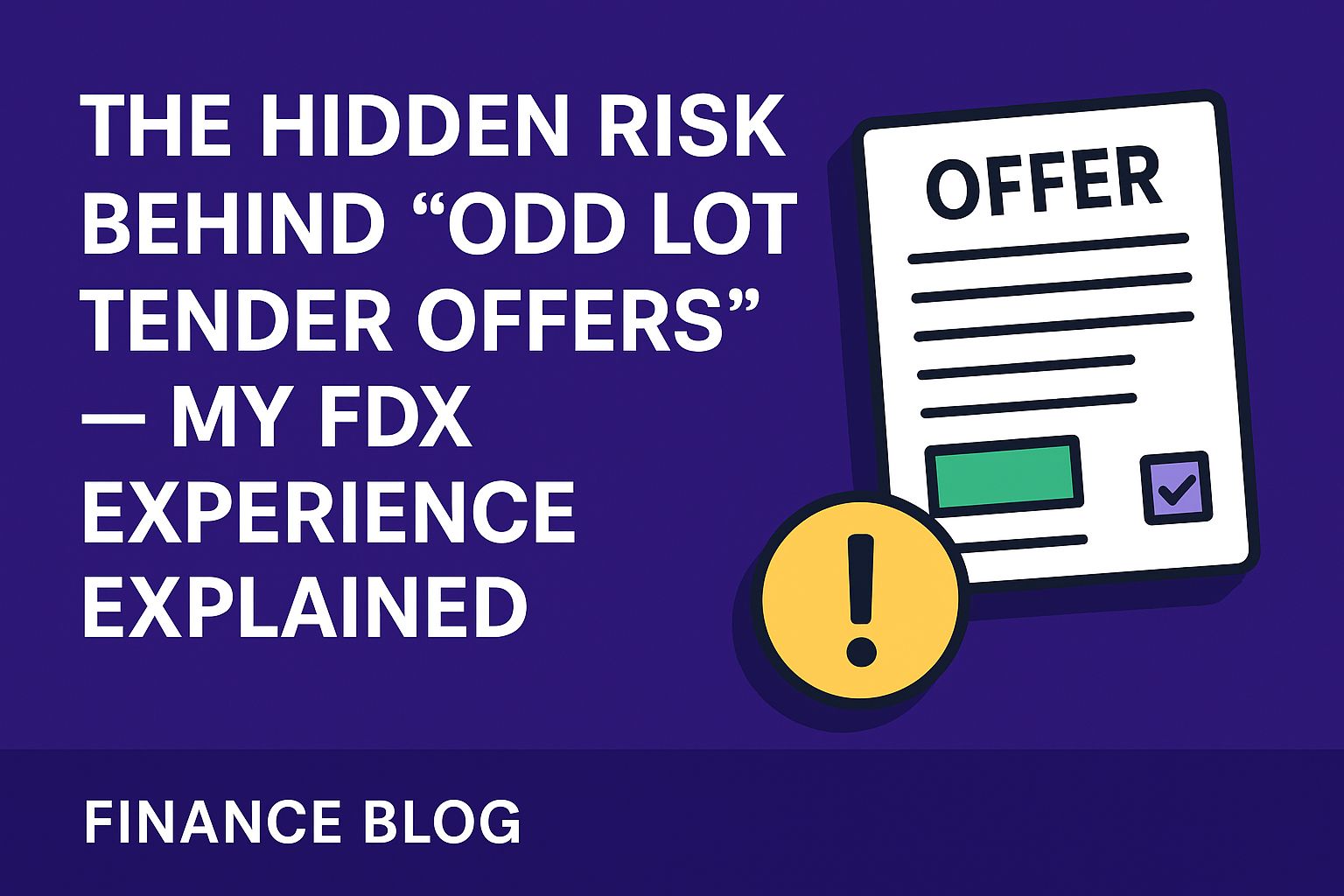
In early November 2025, I got a corporate action notice from E*TRADE:
“Odd Lot Tender Offer for FDX — Due November 12, 2025.”
At first, it sounded like a legitimate opportunity. A tender offer for a blue-chip company like FedEx? That’s usually a sign of a buyback or restructuring. But something didn’t add up — there had been no press release, no investor relations update, no coverage in financial news.
Curiosity took over. I started digging.
Definition: What Is an Odd Lot Tender Offer?
An Odd Lot Tender Offer is a corporate buyback program targeted specifically at shareholders owning fewer than 100 shares — known as odd lots.
Here’s how it typically works:
- The company offers to repurchase its own shares directly from shareholders at a set price.
- Holders of small, odd-lot positions are often given priority — meaning their shares are accepted without proration.
- The goal is to streamline the shareholder base and reduce administrative costs associated with managing small accounts.
Companies use this tool when:
- They have excess cash and want to reduce outstanding shares,
- They’re cleaning up their registry after a stock split, spin-off, or merger, or
- They want to offer liquidity to retail shareholders who may find it costly to sell small holdings.
When a company runs its own odd-lot offer, it’s normally announced publicly through SEC filings and press releases. If you can’t find that announcement, the offer probably isn’t coming from the company.
Want to see how a company-led tender works? Here’s my breakdown of how companies buy back shares through a tender process, using WEX’s $750M Dutch auction.
Research: What FDX Actually Announced
I checked every credible source:
- FedEx’s Investor Relations page
- Recent SEC filings (Form 8-K, S-4, and Tender Offer Statements)
- Business wire releases and major financial news outlets
Nothing.
No mention of any FedEx-led tender offer in October or November 2025.
The only FedEx corporate actions around that time involved debt exchange offers — related to senior notes — not any buyback of common stock.
That’s when the red flag went up: this tender wasn’t coming from FedEx.
Suspecting: A Third-Party Offer
The more I looked, the clearer it became: the “offer” in my account was not initiated by FedEx at all.
It was a third-party tender offer, commonly referred to as a mini-tender.
These are offers made by outside firms — not the company — to purchase shares directly from existing shareholders.
They look official because brokers like E*TRADE or Fidelity typically pass tender offer materials along to their clients. But that doesn’t mean the company itself is involved.
Once I opened the “Offer Materials” link, my suspicion was confirmed — it was a mini-tender from an external investment firm, not FedEx.
Reason: Why Third Parties Do This
Mini-tenders are clever — and controversial.
Here’s how they work:
- The offeror (often an investment fund) offers to buy less than 5% of the company’s shares — a key threshold that allows them to avoid the SEC’s full disclosure and procedural rules.
- They often offer below the current market price, hoping that retail investors will tender their shares without realizing it’s a poor deal. (According to the SEC, some bidders instead offer a premium and then extend the offer, betting the market price will rise before it closes.)
- Once accepted, the firm turns around and resells the shares in the open market at a higher price — pocketing the difference.
The SEC has repeatedly warned investors about these tactics, stating that mini-tenders lack the protections of standard tender offers and can be misleading or deceptive.
In short, they profit from confusion — not from genuine investment opportunity.
For example, in October 2015 Yum! Brands publicly recommended that shareholders reject an unsolicited mini-tender offer by TRC Capital Corporation for up to 2 million shares (about 0.46% of outstanding stock) at $65.63 per share, about 4.3% below the prior closing price. Yum! said it was not associated with the offer. (Yum! Brands press release on SEC EDGAR)
Conclusion: A Lesson in Investor Caution
At first glance, the “FDX Odd Lot Tender Offer” looked like a legitimate corporate action — even showing up in my E*TRADE dashboard with a due date and “Elect” button.
But a little research revealed the truth: this wasn’t from FedEx Corporation. It was a third-party mini-tender, and likely not a good move for most investors.
If you receive a similar alert, remember:
- Read the offer materials carefully. Check who’s making the offer — if it’s not the company itself, be skeptical.
- Compare the offer price to the market price. Mini-tenders often pay less.
- Visit the company’s Investor Relations page. If the tender isn’t mentioned there, it’s not official.
- When in doubt, don’t tender. Most companies — and the SEC — advise against participating in unsolicited mini-tenders.
Sometimes, doing nothing really is the smartest investment decision you can make.
Frequently Asked Questions
What is an odd lot tender offer?
It’s an offer to buy shares from shareholders who hold fewer than 100 shares (an “odd lot”). When a company makes the offer, it’s usually a way to buy back stock and trim the number of small accounts it has to service. Odd-lot holders often get priority, so their shares are accepted without being cut back (prorated).
Is an odd lot tender offer a good deal?
It depends on who is making the offer and at what price. A company-led offer may be at or above the market price. A third-party mini-tender may be below the market price. Always compare the offer price to the current market price, after any fees or deductions, before you click “Elect.”
What is a mini-tender offer, and how is it different?
A mini-tender is a tender offer for less than 5% of a company’s shares, usually from an outside firm, not the company. According to the SEC, mini-tenders don’t carry many of the protections of larger tender offers, such as full disclosure filings, withdrawal rights and pro-rata treatment. In many cases you can’t change your mind once you’ve tendered. (SEC: Mini-Tender Offers: Tips for Investors)
How can I tell if an offer is from the company or a third party?
Open the offer materials and look at who the “bidder” or “offeror” is. Then check the company’s investor relations page and its SEC filings for an announcement. If the company isn’t mentioned as the buyer, and there’s no press release or filing from the company, treat it as a third-party offer and be skeptical. Companies sometimes publicly urge shareholders to reject these offers.
What happens if I ignore an odd lot tender offer?
Usually nothing. Tender offers are voluntary, so if you don’t respond, you simply keep your shares. Check your broker’s notice to confirm that no action means no participation.
Related Articles:
- My 3-Engine Investment Strategy: Growth, Stability, and Dividends
- Beginner guide to ETF Investing
- Stock Market Basics: What It Really Means to Own a Stock
Financial and Legal Disclaimer
The content provided on HelpYourFinances.com is intended for general informational purposes only and does not constitute financial, legal, or professional advice. While we make every effort to ensure the accuracy and reliability of the information presented, it is important to understand that financial and legal matters are complex and highly individual.
HelpYourFinances.com is not a licensed financial planner, investment advisor, legal professional, or law firm. The materials on this website should not be considered a substitute for personalized advice from qualified financial advisors, attorneys, or other licensed professionals who can assess your unique situation.
Before making any financial, legal, or other important decisions, we strongly encourage you to seek advice from qualified experts. Any reliance you place on the information provided here is strictly at your own risk. HelpYourFinances.com, its owners, and contributors disclaim any liability for actions taken based on the content of this website.