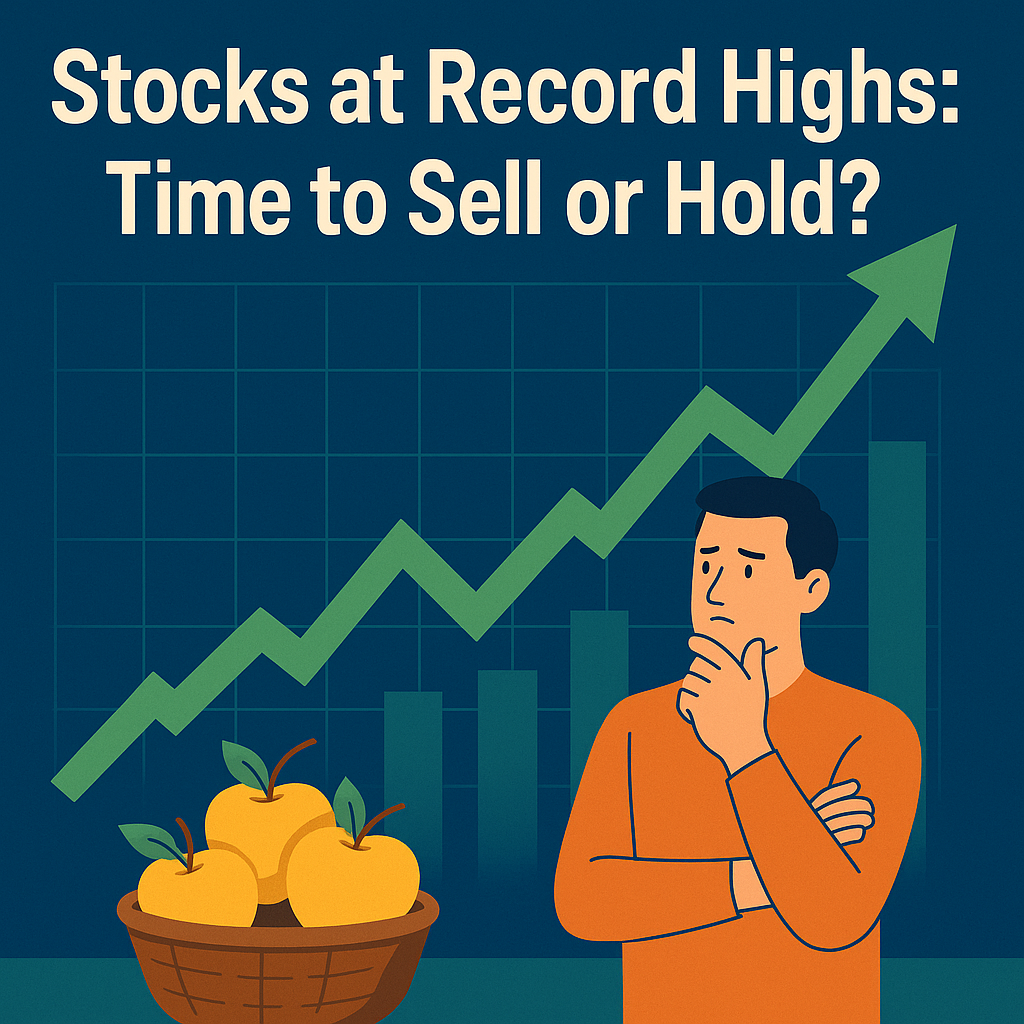
📈 Stocks Are Hitting All-Time Highs… Is It Time to Sell?
It’s been an exciting few weeks for investors.
Both the S&P 500 and Nasdaq have been dancing around record highs, giving portfolios a much-needed boost. But with those green numbers come a tough, often emotional question:
“Should I cash out and lock in these gains… or let it ride?”
Let’s break down what’s happened in the market lately, the mental tug-of-war investors face during rallies, and how to build a disciplined strategy that helps you exit smartly—not emotionally.
🗓️ Last 4 Weeks: The Market at a Glance
The market’s been on a tear. Here’s a snapshot of the highlights:
- July 17, 2025: Both the S&P 500 and Nasdaq set new record highs thanks to strong earnings and a cooling inflation report.
- July 21, 2025: The S&P 500 closed at an all-time high of 6,315.13, and the Nasdaq hit 21,006.05—marking one of the best stretches in recent history.
- July 18–23, 2025: These indexes hovered near record territory for several days, riding a wave of tech optimism and merger buzz.
- Tech leaders like Nvidia, Microsoft, and Apple continued to outperform, pulling the broader indexes higher.
With this kind of performance, many investors are celebrating… but also silently wondering: “Is this the top?”
😬 The Dilemma: Fear of Missing Out vs. Fear of Losing Gains
This is the mental tug-of-war that even seasoned investors struggle with.
On one side:
“What if I sell today and the stock climbs even higher tomorrow?”
On the other:
“If I don’t sell and the market crashes, I’ll regret watching all those gains disappear.”
It’s like sitting at a blackjack table on a hot streak. You know you should probably walk away… but what if the next card is a 21?
This internal debate leads to paralysis. Investors freeze, do nothing, and often end up watching their portfolio rise… and then fall—without ever locking in the profit.
🎯 A Smarter Approach: Set a Strategy, Stick to It
Rather than guessing market tops or letting emotions rule the day, smart investors rely on a strategy built on clear price targets, portfolio discipline, and tax awareness.
✅ Step 1: Set a Profit Target (Example: 20–25%)
Pick a number. Seriously.
Maybe it’s 20% gain, or 25%, or even doubling your investment. Having a pre-defined exit point removes emotion and helps you act objectively.
📌 Example:
You bought QQQ at $400. You set a target to take some profits at 25% gain, which is $500. Once it hits that level, you sell a portion—not necessarily all—of your position.
✅ Step 2: Use Trailing Stops
A trailing stop automatically adjusts upward with your stock price and sells if it drops by a certain percentage. It’s like giving your winner room to grow while protecting the downside.
📌 Example:
Set a 15% trailing stop on your stock. If it rises from $100 to $120, your stop moves to $102. If it dips below $102, the position closes—locking in a profit.
✅ Step 3: Rebalance Regularly
When one stock or ETF grows too large in your portfolio (say, 30% of your total assets), it’s time to trim it back and rebalance.
This keeps your risk in check and ensures you’re not overly exposed to one big mover.
✅ Step 4: Be Tax-Smart
- Hold investments longer than a year for lower long-term capital gains tax.
- Use tax-loss harvesting to offset gains with any losers you may have elsewhere in your portfolio.
- In high-income years, consider donating appreciated shares to charity to avoid taxes altogether.
🧠 Final Thought: Discipline Beats Emotion
Timing the exact top is nearly impossible. Even the pros miss it.
But you can control your plan. You can decide when to take profits, protect gains, and keep your portfolio balanced—without falling victim to FOMO or fear.
Think of your investing journey like gardening. When the fruit is ripe, pick it. Don’t wait so long that it rots on the vine.
💡 Key Takeaways
- Markets have hit multiple all-time highs over the past few weeks—especially the S&P 500 and Nasdaq.
- Selling at the top feels good… but knowing when that is? Almost impossible.
- Create a system: define profit targets, use trailing stops, rebalance regularly, and be smart about taxes.
- Discipline beats guessing. Plan your exit before emotions take over.
Need help setting your targets or building a system?
Feel free to reach out—I’d be happy to walk you through a strategy that fits your goals.
Related Articles:
Financial Disclaimer
The information provided on HelpyYourFinances.com is for general informational purposes only and is not intended to be financial advice. While we strive to ensure the accuracy and reliability of the content, it is important to remember that financial decisions are personal and should be tailored to your individual circumstances.
We strongly recommend that you consult with a qualified financial advisor or other professional before making any financial decisions. The content on this website should not be considered a substitute for professional financial advice, analysis, or recommendations. Any reliance you place on the information provided is strictly at your own risk