
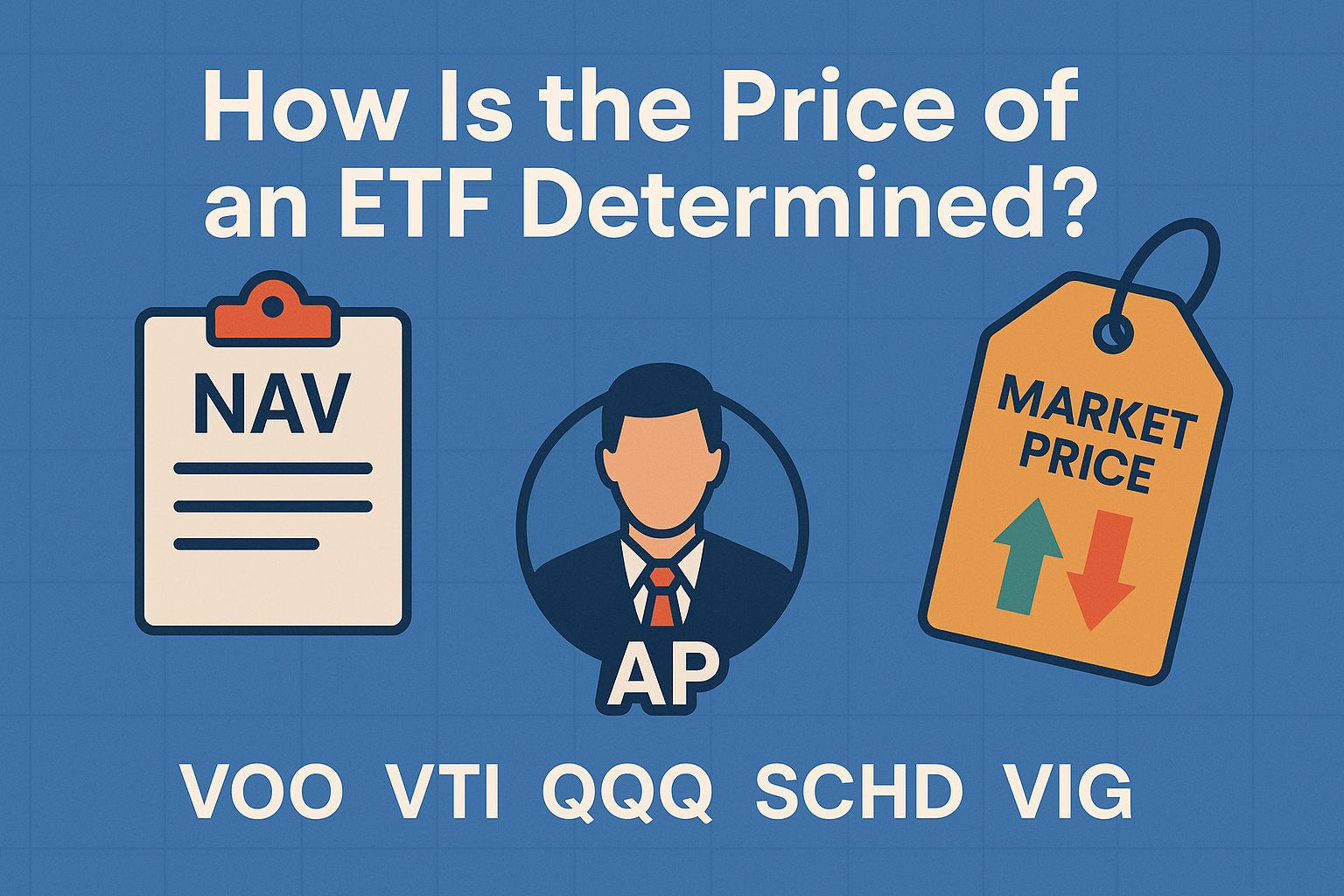
If you’re investing in ETFs like VOO, VTI, QQQ, SCHD, or VIG, you’re already on a smart path. These funds offer broad market exposure, low fees, and daily liquidity. But have you ever paused to ask yourself: How is the price of an ETF actually determined? And why does it seem so efficient?
Let’s dive deep into the pricing engine that powers your favorite ETFs.
🌊 What Is an ETF?
An ETF (Exchange-Traded Fund) is a basket of investments — like stocks, bonds, or other securities — bundled into a single fund that trades on an exchange. Just like a stock, you can buy or sell an ETF throughout the trading day.
For example:
- VOO tracks the S&P 500.
- VTI covers the entire U.S. stock market.
- QQQ follows the Nasdaq-100.
- SCHD focuses on dividend-paying U.S. companies.
- VIG targets companies with a strong history of dividend growth.
You can think of an ETF as a mutual fund you can trade like a stock — fast, flexible, and transparent.
📈 How ETF Prices Are Determined
Unlike mutual funds, which are priced once per day at market close, ETFs trade all day. But their prices are governed by two things:
1. Net Asset Value (NAV)
This is the total value of all the assets in the ETF divided by the number of shares outstanding. It reflects the true value of the fund, but is only calculated once a day after the market closes.
2. Market Price
This is the price you see during the trading day — driven by supply and demand, just like a regular stock.
Because ETFs trade like stocks, market price can temporarily drift from NAV. But don’t worry, there’s a behind-the-scenes system in place to keep prices in check…
⚖️ The Arbitrage Mechanism
If the market price of an ETF drifts away from its NAV, Authorized Participants (APs) step in to close the gap. They do this through a process called arbitrage:
- If the ETF trades above its NAV: APs buy the underlying securities and exchange them for ETF shares to sell at the higher market price.
- If the ETF trades below NAV: APs buy ETF shares at the discount, redeem them for the underlying assets, and sell those for profit.
This buying and selling activity helps pull the ETF market price back toward its NAV, often within seconds.
🧑🎓 Who Are the Authorized Participants?
APs are typically large financial institutions — think:
- Goldman Sachs
- JPMorgan
- Citadel Securities
- Jane Street
- Morgan Stanley
- Virtu Financial
These firms work closely with ETF issuers (like Vanguard, Schwab, and BlackRock) to maintain liquidity and price efficiency. Important note:
The ETF issuer is not usually the AP.
So for example, Schwab issues SCHD, but the APs responsible for arbitraging and managing price alignment are external firms like JPMorgan or Citadel.
🪖 Is This All Automated?
Yes and no.
- The arbitrage opportunity detection and trading are largely algorithmic, occurring in milliseconds.
- The actual creation or redemption of ETF shares in large blocks (usually 50,000 shares) involves some human oversight and settlement.
It’s a smooth hybrid: automation for speed, humans for compliance and coordination.
🌟 Why This Matters for VOO, QQQ, VTI, SCHD, and VIG Investors
All the ETFs in your portfolio benefit from this system:
- VOO & VTI: High-volume, ultra-liquid ETFs. Price deviations from NAV are minimal and corrected almost instantly.
- QQQ: Very actively traded. APs ensure the ETF accurately reflects fast-moving tech-heavy holdings.
- SCHD & VIG: While slightly less traded than the others, they still benefit from AP oversight and tight price-to-NAV tracking.
This system ensures that you can trade these ETFs confidently, knowing that the price you’re paying (or selling at) reflects the real value of what you own.
📅 Final Thoughts
ETFs are like high-performance vehicles: they run fast, smooth, and efficiently — but there’s a whole pit crew behind the scenes making sure the wheels don’t fall off.
Understanding how ETF prices are determined, and the role of APs and arbitrage, gives you a deeper appreciation for the tools you use to build wealth.
Next time you buy VTI or QQQ, know that you’re not just investing in the market — you’re participating in one of the most sophisticated, investor-friendly systems in modern finance.
Looking to build a diversified ETF portfolio or want to understand how fees, spreads, and pricing impact your long-term returns? Let’s talk.
Related Articles:
Financial Disclaimer
The information provided on HelpyYourFinances.com is for general informational purposes only and is not intended to be financial advice. While we strive to ensure the accuracy and reliability of the content, it is important to remember that financial decisions are personal and should be tailored to your individual circumstances.
We strongly recommend that you consult with a qualified financial advisor or other professional before making any financial decisions. The content on this website should not be considered a substitute for professional financial advice, analysis, or recommendations. Any reliance you place on the information provided is strictly at your own risk.